
Amid Gaza's Ruins, a Father Searches for His Newborn Son—But Doesn't Know If the Surviving Child Is His
Zero Signal Staff
Published April 16, 2026 at 2:34 PM ET · 2 days ago
Al Jazeera
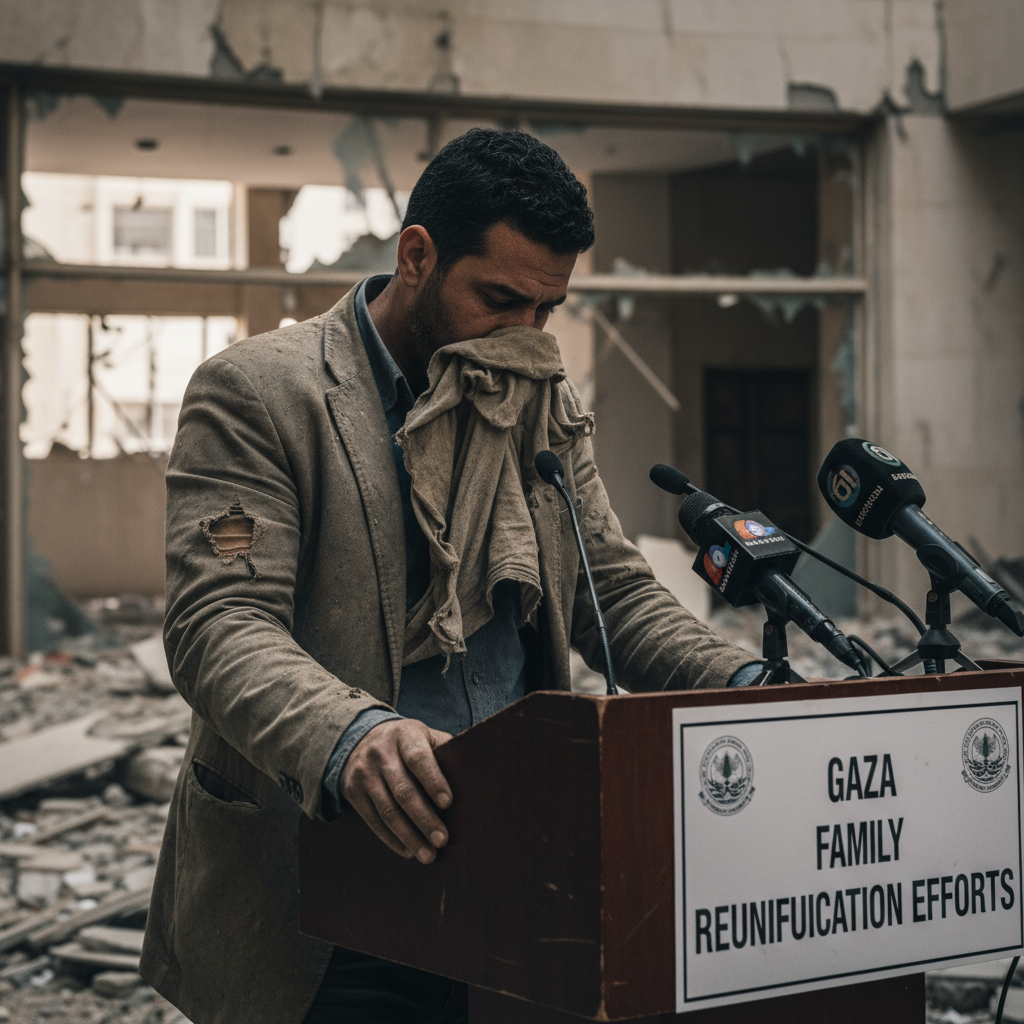
Mohammed Lubbad lost almost everything in a single moment.
Mohammed Lubbad lost almost everything in a single moment. On October 13, 2023, six days after the war began, an Israeli strike on his family home in northern Gaza killed his wife Amal, his five-year-old daughter Rana, his mother, brother, sister-in-law, and nephew. Amal was eight months pregnant. At Kamal Adwan Hospital, doctors delivered a healthy baby boy via emergency Caesarean section. Amal survived the delivery but died nine days later from her injuries. Now, over two years later, Lubbad faces an impossible situation: the surviving infant may not be his son. A competing family claims the child. Hospital records are lost. DNA testing is impossible. And uncertainty is consuming him.
The Details
The chaos of war created the conditions for this nightmare. When Amal arrived at Kamal Adwan Hospital in early October 2023, she was rushed into surgery. The Caesarean section succeeded—a premature but healthy baby boy was born. But hospitals in Gaza during wartime are not places where careful recordkeeping survives. When Amal was transferred to al-Shifa Hospital following delivery, she carried injuries from the same strike that had killed so much of her family. She died on October 22, 2023, from head trauma and abdominal wounds.
Lubbad's newborn son was among approximately 29 premature infants evacuated from al-Shifa's neonatal intensive care unit in November 2023, after Israeli forces besieged the hospital and power failures threatened the incubators. The evacuation—carried out by the Red Crescent and World Health Organization—sent the babies to Egypt. Seven of them died before or shortly after arrival. By March 31, 2026, when a U.N.-organized mission brought some of the surviving children back to Gaza, the records of who was who had become fragmented and uncertain.
An identification bracelet on the baby indicated he belonged to another family. That family has claimed the child as their own. Lubbad believes the bracelet is wrong—a consequence of the overwhelmed, destroyed systems that characterized the hospitals during the siege. Gaza's police investigations department has acknowledged the dispute, confirming it arose after two women in similar circumstances gave birth prematurely. Both babies initially survived. Both were placed in the NICU. But when the siege cut power and temperatures dropped, several infants did not make it. Hospital staff testimonies suggest one of the two babies born to mothers now deceased did not survive, leaving one baby at the center of two families' competing claims.
The only way to end the uncertainty is DNA testing. Lubbad has said he is ready for any result—he wants certainty, not comfort. But Gaza's specialized laboratories have been destroyed or rendered non-operational during the war. Police investigators have called for either new DNA testing equipment to be provided inside Gaza, or for samples to be transferred through international institutions to accredited laboratories in Egypt or Jordan. Neither has happened.
Context
The evacuation of premature infants from al-Shifa Hospital in late 2023 was one of the humanitarian consequences of the war that has now killed more than 72,000 Palestinians according to Gaza health authorities. Al-Shifa, Gaza's largest hospital, was besieged by Israeli forces in November 2023. Israel claimed Hamas used the facility as a military command center; Hamas and hospital officials denied the accusation. The siege and power failures created a crisis in the neonatal unit, where incubators depend on electricity to regulate temperature for the most fragile patients.
The broader story of the evacuated babies became a symbol of hope when 11 of them returned to Gaza in late March 2026, part of a ceasefire arrangement brokered by the United States in October 2025 and enabled by the reopening of the Rafah border crossing. Reunions between children and their families became moments of rare joy in a devastated territory. But for Lubbad and at least one other family, the return brought not resolution but a profound, ongoing uncertainty.
Al-Shifa's director, Mohamed Abu Selmia, has stated that approximately 52 percent of basic medicines and 75 percent of medical supplies remain unavailable in Gaza. The destruction of medical infrastructure and the absence of functioning forensic facilities means that even straightforward identity questions cannot be answered with the tools modern medicine considers routine.
What's Next
Lubbad has said he plans to organize a protest outside al-Shifa Hospital, calling on both domestic and international authorities to find a solution. The case has drawn attention from Gaza's police investigations department, which has formally stated that the situation has profound human and psychological consequences for both families involved. Without DNA testing capability in Gaza or a coordinated international effort to facilitate sample transfers, the dispute appears likely to remain unresolved indefinitely.
The case raises broader questions about accountability for records and identity in conflict zones. When hospitals are destroyed, when evacuation happens under siege conditions, when families are separated and records are lost, the ordinary apparatus of proof—documents, registrations, institutional memory—collapses. Lubbad's situation is likely not unique in Gaza, though his story has drawn public attention. The question of how families can be reunited and identities confirmed in the aftermath of mass displacement and institutional destruction remains largely unanswered. For now, Lubbad waits, unable to work or live normally, separated from a child who may or may not be his son.
Never Miss a Signal
Get the latest breaking news and daily briefings from Zero Signal News directly to your inbox.