
Broadcaster Andy Kershaw Dies Aged 66 Following Cancer Diagnosis
Zero Signal Staff
Published April 17, 2026 at 8:31 AM ET · 1 day ago
BBC News
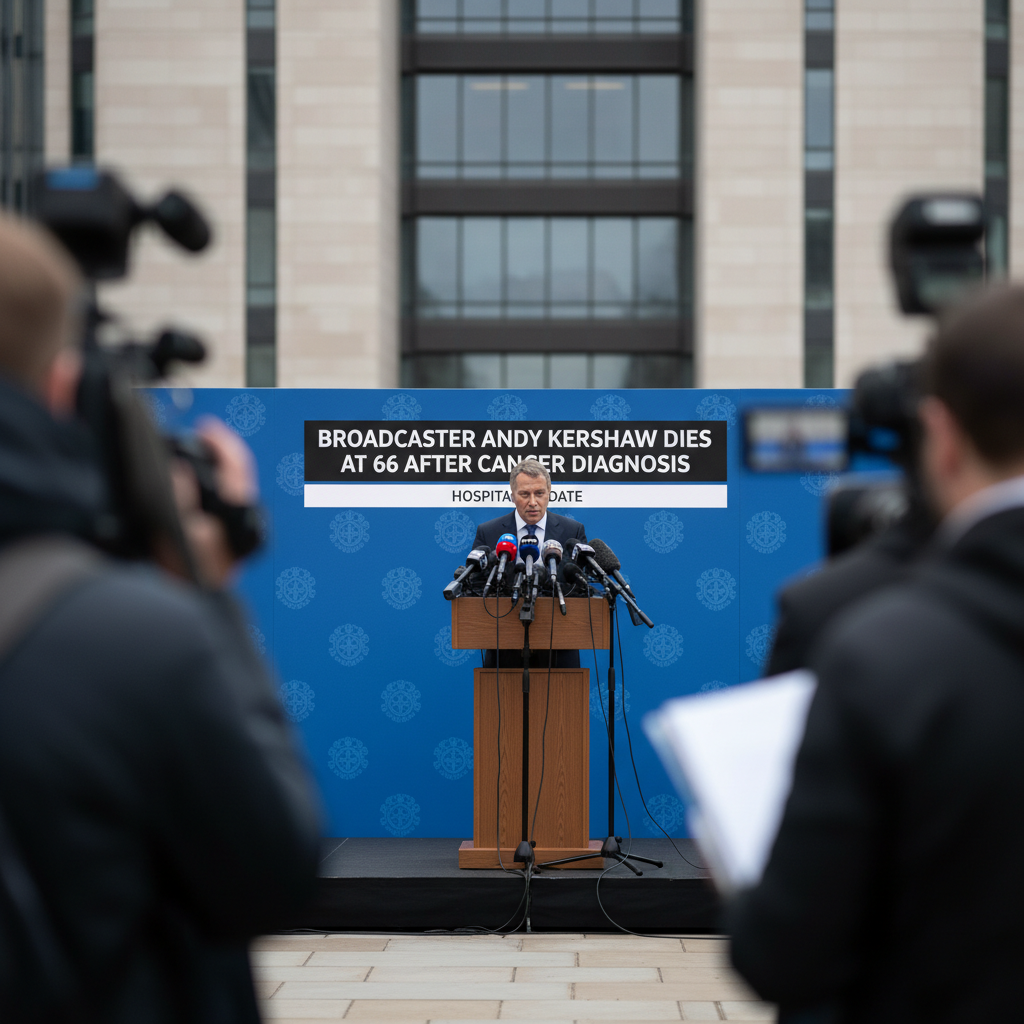
Andy Kershaw, the influential former BBC Radio 1 DJ and Live Aid presenter, has died at the age of 66. His family confirmed that he passed away around 19:30 BST on Thursday, April 16, 2026.
Andy Kershaw, the influential former BBC Radio 1 DJ and Live Aid presenter, has died at the age of 66. His family confirmed that he passed away around 19:30 BST on Thursday, April 16, 2026. Kershaw had been battling cancer, a diagnosis announced in January 2026.
The Details
Kershaw's death follows a health struggle that began in August 2025, when he was diagnosed with cancer that affected his spine. By January 2026, the condition had progressed to the point where he was unable to walk. Despite the severity of his illness, Kershaw maintained a defiant spirit, stating in a January announcement that he was determined to outlive several world leaders and popular entertainers.
Throughout his career, Kershaw was celebrated for his eclectic musical taste and his tireless championship of world music. He spent 15 years at BBC Radio 1 between 1985 and 2000, where he was regarded by many as a potential successor to the legendary DJ John Peel. His broadcasting philosophy, influenced by his mentor John Walters, focused on providing the public with music they did not yet know they wanted.
His impact on global music was significant; he was the first to bring Ali Farka Touré to mainstream national radio in the UK. A documentary he produced with Touré in Mali marked a historic milestone as the first program to be broadcast simultaneously on both BBC Radio 1 and Radio 4.
Beyond the studio, Kershaw was a visible presence during major global events. In 1985, he served as one of the BBC's television presenters for Live Aid, the massive benefit concert organized to combat the Ethiopian famine. He also demonstrated a commitment to reporting from the front lines of global conflict, traveling to Rwanda during the 1994 genocide and to Angola during its civil war.
His versatility as a broadcaster was evident in his work across the BBC. In 1984, he presented BBC 2's 'The Old Grey Whistle Test' after being recruited by producer Trevor Dann. Following his tenure at Radio 1, he continued to work with BBC Radio 3 and Radio 4, including reporting for the 'Today' programme.
Kershaw's career was not without controversy. In 2008, he served a three-month prison sentence for breaching a restraining order regarding the mother of his two children, Juliette Banner. He later received a suspended six-month sentence for a subsequent breach of the same order.
Context
Born on November 9, 1959, in Littleborough, Lancashire, Kershaw began his professional journey at Radio Aire in Leeds during the early 1980s. After a period of redundancy in 1983, he briefly worked as a driver and roadie for singer Billy Bragg before his rise in national broadcasting.
His early success was recognized quickly, winning a gold Sony Award in 1987 during his first year of broadcasting. His influence on Radio 1 remained a staple of the station's late-night programming until a scheduling overhaul in 2000 led to the cancellation of his weekly show. His final sessions on the station featured performances by Willie Nelson and Lou Reed.
In later years, Kershaw continued to explore the intersection of music and geography. He completed an ambitious musical tour covering Iraq, Iran, and North Korea for BBC Radio 3. In 2011, he returned to the BBC to co-host 'Music Planet' with Lucy Durán, a series tied to the 'Human Planet' documentary series on BBC One. He also shared his personal and professional reflections in his 2011 autobiography, titled 'No Off Switch'.
What's Next
Tributes to Kershaw's contribution to world music and broadcasting are expected to pour in from the international music community and former BBC colleagues. His legacy as a pioneer who brought non-Western music to British ears is likely to be the central theme of these commemorations.
Following the confirmation of his death, the public and music historians are expected to revisit his archival work, particularly his documentaries and the pioneering recordings of West African artists. His career serves as a blueprint for the 'curator' style of DJing that prioritizes discovery over popularity.
Never Miss a Signal
Get the latest breaking news and daily briefings from Zero Signal News directly to your inbox.