
CENTCOM says Project Freedom prioritizes safe merchant transit through the Strait of Hormuz
Zero Signal Staff
Published May 6, 2026 at 12:06 AM ET · 159 days ago
Centcom, Al Jazeera, BBC, Associated Press
U.S.
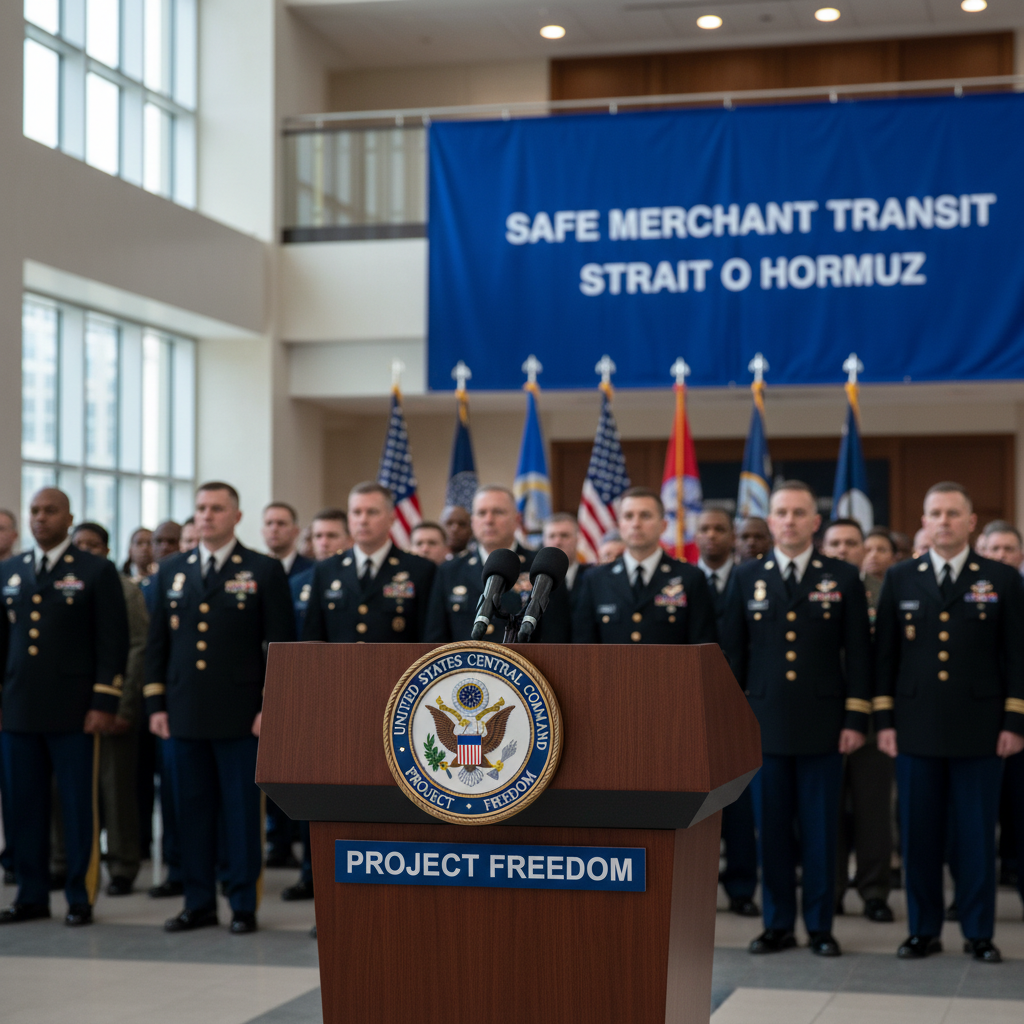
U.S. Central Command (CENTCOM) has outlined the core priorities of Project Freedom, the operation launched to restore commercial shipping routes through the Strait of Hormuz, as securing safe passage for merchant vessels and maintaining a naval blockade on Iran. The operation began May 4 with substantial U.S. military assets, and CENTCOM has reported successful initial transits, though Iranian forces have disputed those claims and opened fire on both warships and commercial vessels.
The Details
In a May 5 interview with Al Jazeera, CENTCOM spokesperson Tim Hawkins said the mission's main priorities are securing safe routes for merchant vessels and blockading Iran.
Context
The strait, which CENTCOM said carries roughly a quarter of the world's oil trade at sea along with significant fuel and fertilizer volumes, has remained largely blocked since the United States and Israel launched air strikes on Iran on February 28 and Iran responded by restricting the waterway.
According to a CENTCOM press release, U.S. support for Project Freedom began May 4 and includes guided-missile destroyers, more than 100 land- and sea-based aircraft, multi-domain unmanned platforms, and approximately 15,000 service members.
Adm. Brad Cooper, in the same press release, stated: "Our support for this defensive mission is essential to regional security and the global economy as we also maintain the naval blockade."
BBC reported that President Donald Trump announced the initiative to help guide stranded ships out of the strait starting Monday. Trump described Project Freedom as "a humanitarian gesture meant to free up people, companies, and Countries that have done absolutely nothing wrong," according to BBC.
CENTCOM said two U.S.-flagged merchant vessels successfully transited the strait as a first step of the operation, and Maersk confirmed one of its vessels exited the Gulf accompanied by the U.S. military, BBC reported. However, the Islamic Revolutionary Guard Corps told BBC that no vessels had passed through the strait—a claim that remains unresolved.
BBC reported that Iran fired cruise missiles at U.S. warships and U.S.-flagged commercial ships, while also deploying drones and small boats against commercial shipping. CENTCOM denied Iranian claims that a U.S. warship had been hit, and told BBC that U.S. helicopters sank six small Iranian boats. Iran denied the U.S. account, including the claim that six boats were sunk.
BBC further reported that Trump paused Project Freedom for a short period to test whether the United States and Iran could reach an agreement.
Amid the operation's launch, concerns have been raised about its coordination. Tim Wilkins of Intertanko told BBC that the Trump administration had not established coordination for the operation, leaving tanker operators worried about safety and insurance.
What's Next
The operation is positioned as a sustained effort to keep commercial routes open through a strategically vital waterway. The conflicting claims from CENTCOM and Iranian authorities over vessel transits and engagement outcomes remain unverified, and any broader diplomatic breakthrough linked to the temporary pause reported by BBC is yet to emerge. With roughly a quarter of global oil trade at sea moving through the strait, the operation's success or failure carries direct implications for energy markets and international shipping.
Never Miss a Signal
Get the latest breaking news and daily briefings from Zero Signal News directly to your inbox.