
China's EV Price War Gives Way to an In-Car AI Arms Race
Zero Signal Staff
Published May 1, 2026 at 12:32 PM ET · 148 days ago
CNBC; Gasgoo
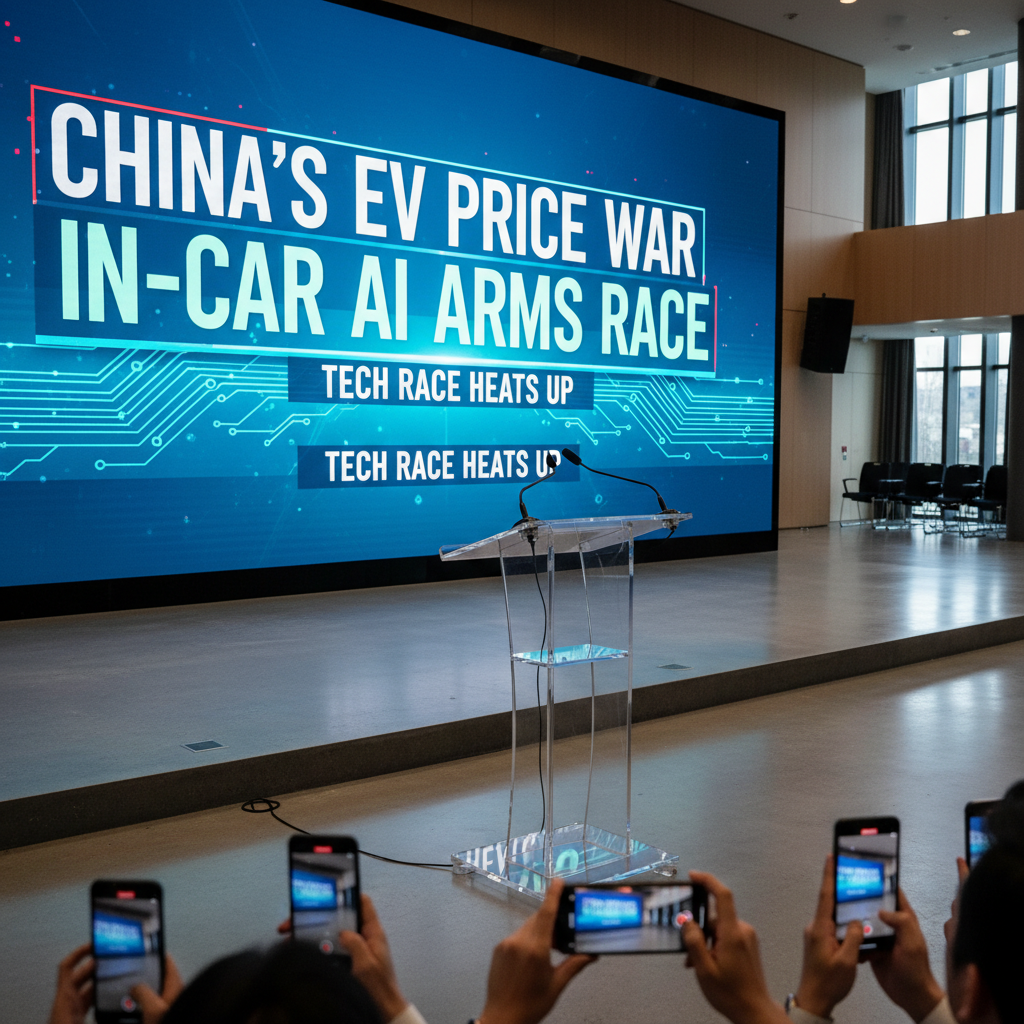
China's electric vehicle market, defined for years by relentless price cuts, is shifting to a new battleground: artificial intelligence built into the cockpit.
China's electric vehicle market, defined for years by relentless price cuts, is shifting to a new battleground: artificial intelligence built into the cockpit. ByteDance, Alibaba, and legacy automakers including Volkswagen are racing to embed AI agents into vehicles across the Chinese market, as analysts warn that technology parity may undercut the very differentiation automakers are chasing.
The Details
The shift has been building across successive product cycles. Competition in China's EV sector moved from battery range to driver-assist systems to automotive chips, and now to in-car AI features, according to CNBC. The result is a market where car interiors are becoming software platforms, and where the race to install AI is as intense as the price cutting that preceded it.
Stephen Dyer, head of AlixPartners' Asia automotive practice, put it plainly. "The price war has turned into a feature war around cockpit technology," he told CNBC. But Dyer's firm also issued a caution: among top-selling EVs in China priced above 100,000 yuan, driver-assist and entertainment functions are increasingly similar, making durable technological differentiation harder to sustain, according to AlixPartners data cited by CNBC.
The price pressure driving that feature escalation shows no sign of letting up. Fermin Soneira, CEO of the Audi and SAIC Cooperation Project, said the competitive dynamics are structural. "This price war is not going to really stop in the next month," he told CNBC, citing persistent oversupply across the Chinese market.
Against that backdrop, ByteDance — best known outside China as the owner of TikTok — has emerged as a significant force in automotive AI through its cloud and AI arm, Volcano Engine. The unit announced at Auto China 2026 that its Doubao AI model has been integrated by more than 50 automotive brands across 145 vehicle models, reaching an installed base above 7 million vehicles, according to Gasgoo's reporting from the show.
Alibaba is moving on a parallel track. The company announced that its Qwen AI model will be integrated into vehicles from BYD, Geely, Li Auto, Changan, Dongfeng, BAIC, Great Wall Motor, SAIC Volkswagen, and SAIC IM Motors, according to CNBC. The integration goes beyond voice search: drivers will be able to place food delivery orders, book hotels, purchase attraction tickets, and track packages by speaking to the car.
Volkswagen's China operation is also committing to AI agents at scale. The company said all vehicles built on its China car system will include AI agents from the second half of 2026, drawing on technology from Tencent, Alibaba, and Baidu and running a locally trained large language model directly on the vehicle, according to CNBC. Thomas Ulbrich, Volkswagen's China CTO, described the ambition simply: "The car should be like a companion."
Gasgoo, covering Auto China 2026, characterized the show as a turning point — a shift from generative AI features that functioned mainly as demonstrations toward what the industry is calling agentic AI: systems capable of planning and executing real in-car tasks rather than simply responding to queries.
Context
The current AI push is the latest phase in a long competitive escalation. China's EV market has progressed through distinct stages of feature competition — first range, then autonomous driving assist, then purpose-built automotive chips — and the transition to AI cockpit software follows the same pattern, according to CNBC.
Chinese automakers are leaning into software and service ecosystems in part because the broader EV market's growth rate has slowed even as price competition remains intense, according to CNBC. For automakers facing margin pressure from price wars, software-layer features represent a way to differentiate products without reductions to the sticker price — though AlixPartners' analysis suggests that window may be closing as AI capabilities converge across manufacturers.
The participation of tech platforms like ByteDance and Alibaba underscores how far automotive software has moved from the domain of car companies alone. Both firms bring consumer-facing service networks — food delivery, travel booking, entertainment — that automakers cannot easily replicate in-house, which may explain the breadth of the partnership lists both companies announced at Auto China 2026.
What's Next
Volkswagen has given a concrete timeline: AI agents in its Chinese-market vehicles built on the China car system are expected to arrive in the second half of 2026, according to CNBC. The company's reliance on Tencent, Alibaba, and Baidu for those systems means the launch will function as a test of how well European automakers can integrate domestic Chinese AI infrastructure at scale.
The durability of any competitive advantage built on AI cockpit features remains an open question. AlixPartners' data, cited by CNBC, shows that top-selling EVs above 100,000 yuan are already converging on similar driver-assist and entertainment capabilities. If AI features follow the same trajectory, the current feature war may resolve into the same margin-compressing price dynamic that preceded it.
Never Miss a Signal
Get the latest breaking news and daily briefings from Zero Signal News directly to your inbox.