
Europe's 2025 Climate Report Documents Record Heat, Glacier Loss, and Marine Extremes
Zero Signal Staff
Published April 28, 2026 at 11:41 PM ET · 151 days ago
Copernicus Climate Change Service / World Meteorological Organization / France 24 / AFP / Mirage News
The Copernicus Climate Change Service and the World Meteorological Organization released the European State of the Climate 2025 report on April 29, 2026, documenting a year of record-breaking sea surface temperatures, accelerating glacier loss across
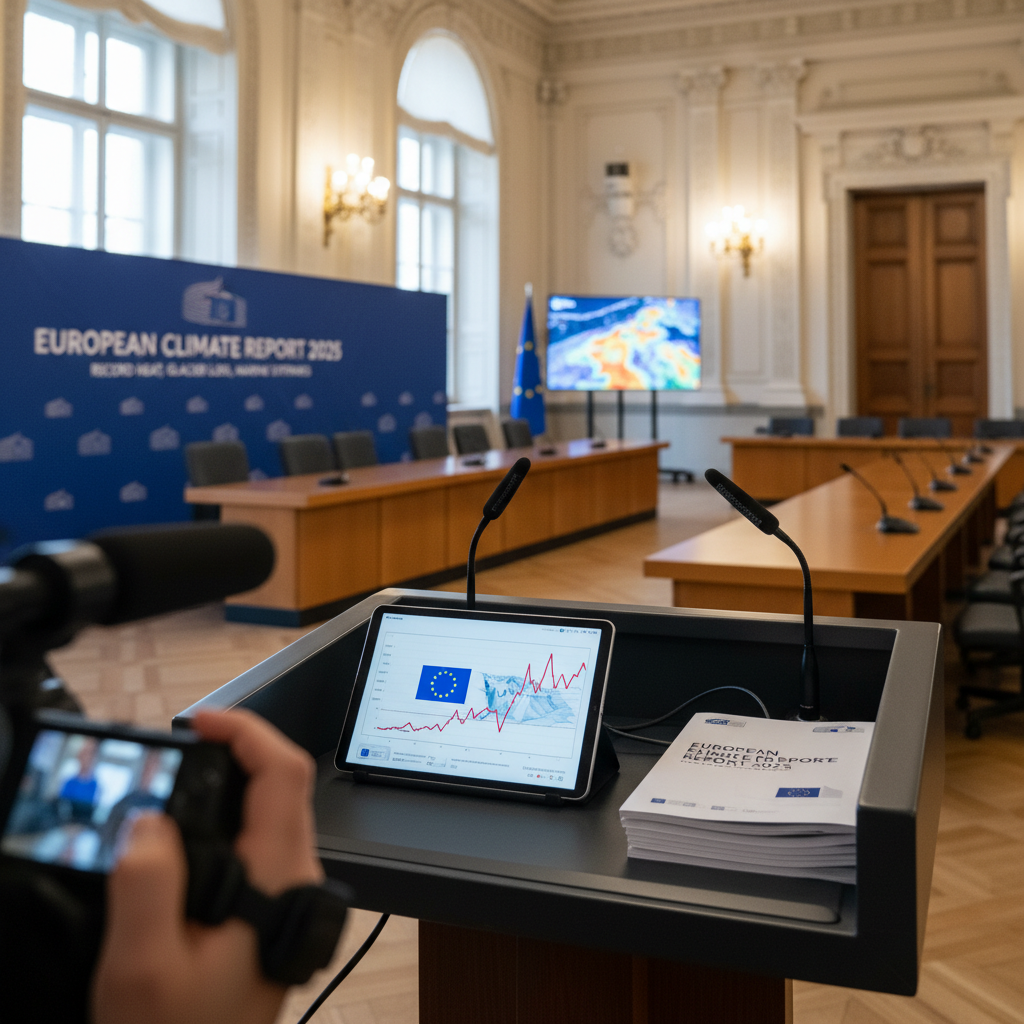
The Copernicus Climate Change Service and the World Meteorological Organization released the European State of the Climate 2025 report on April 29, 2026, documenting a year of record-breaking sea surface temperatures, accelerating glacier loss across all European regions, and a three-week Arctic heatwave that pushed temperatures to 30 degrees Celsius near the Arctic Circle. At least 95 percent of Europe experienced above-average annual temperatures in 2025, according to the report. Renewables outpaced fossil fuels in European electricity generation for the third straight year, the report also found.
The Details
The European State of the Climate 2025 report — compiled by the Copernicus Climate Change Service at the European Centre for Medium-Range Weather Forecasts in partnership with the WMO — covers climate conditions across Europe throughout last year. The publication serves as the authoritative annual benchmark for tracking how rapidly the continent's climate is shifting.
Among the report's most striking land-based findings: a record three-week heatwave struck sub-Arctic Fennoscandia in July 2025, driving temperatures to 30 degrees Celsius near and within the Arctic Circle, according to France 24 and AFP citing the report. The event was notable both for its duration and for where it occurred, in a region historically insulated from the sustained heat events common farther south.
Glaciers across all European regions recorded net mass loss in 2025. Iceland, whose ice sheets have contracted sharply over recent decades, posted its second-largest glacier loss on record, according to Mirage News citing the ECMWF and WMO release. The Greenland Ice Sheet lost 139 gigatonnes of ice during the year, France 24 and AFP reported, citing Copernicus official Samantha Burgess.
Europe's oceans reflected the same pressure. The continent's annual sea surface temperature reached its highest level on record in 2025, and 86 percent of the European ocean region experienced at least one day of strong marine heatwave conditions, according to France 24 and AFP citing the report. Marine heatwaves carry consequences for fisheries, coastal ecosystems, and storm intensity.
On the energy side, the picture was more mixed. Renewables generated 46.4 percent of Europe's electricity in 2025, outperforming fossil fuels for the third consecutive year. Solar power reached a record 12.5 percent contribution to the European electricity mix, France 24 and AFP reported citing the ESOTC 2025 data. The figures represent structural progress on the clean-energy transition even as climate indicators continued to deteriorate.
WMO Secretary-General Celeste Saulo framed the overall trajectory in stark terms at a briefing on the report. "Since 1980, Europe has been warming twice as fast as the global average, making it the fastest warming continent on Earth," Saulo said, according to France 24 and AFP. In a written statement accompanying the report, Saulo added: "This report highlights that Europe is the fastest-warming continent and is experiencing serious impacts from extreme weather and climate change."
European Commission official Mauro Facchini, briefing journalists on the findings, offered a direct assessment: "The climate indicators ... are quite worrying," he said, according to France 24 and AFP.
Context
The European State of the Climate report is produced annually by the Copernicus Climate Change Service, the EU's earth-observation program operated by ECMWF under contract from the European Commission, in partnership with the WMO. The 2025 edition is the latest in a series tracking the acceleration of warming trends on the continent.
The report links Europe's climate extremes to biodiversity impacts and argues that both adaptation measures and the clean-energy transition need to accelerate, according to France 24, AFP, and the WMO. The findings arrive at a moment when European policymakers are navigating competing pressures over energy costs, industrial competitiveness, and long-term climate commitments.
Copernicus states the ESOTC 2025 was compiled by C3S at ECMWF in collaboration with the WMO and is designed to give governments, researchers, and the public a consistent, science-based record of how climate conditions evolved across Europe during the previous year.
What's Next
The full European State of the Climate 2025 report is available at the Copernicus Climate Change Service website. The WMO has published supplementary materials at its media center. Both organizations are expected to brief additional stakeholders as the findings enter broader policy discussions.
The report's conclusions on glacier loss, ocean temperatures, and the pace of the clean-energy transition are likely to inform European Commission climate policy reviews scheduled for the coming months, though no specific legislative actions were announced alongside the April 29 publication.
Never Miss a Signal
Get the latest breaking news and daily briefings from Zero Signal News directly to your inbox.