
FAA Grounds Blue Origin New Glenn After Upper-Stage Failure Destroys Customer Satellite
Zero Signal Staff
Published April 21, 2026 at 5:01 AM ET · 159 days ago
Reuters
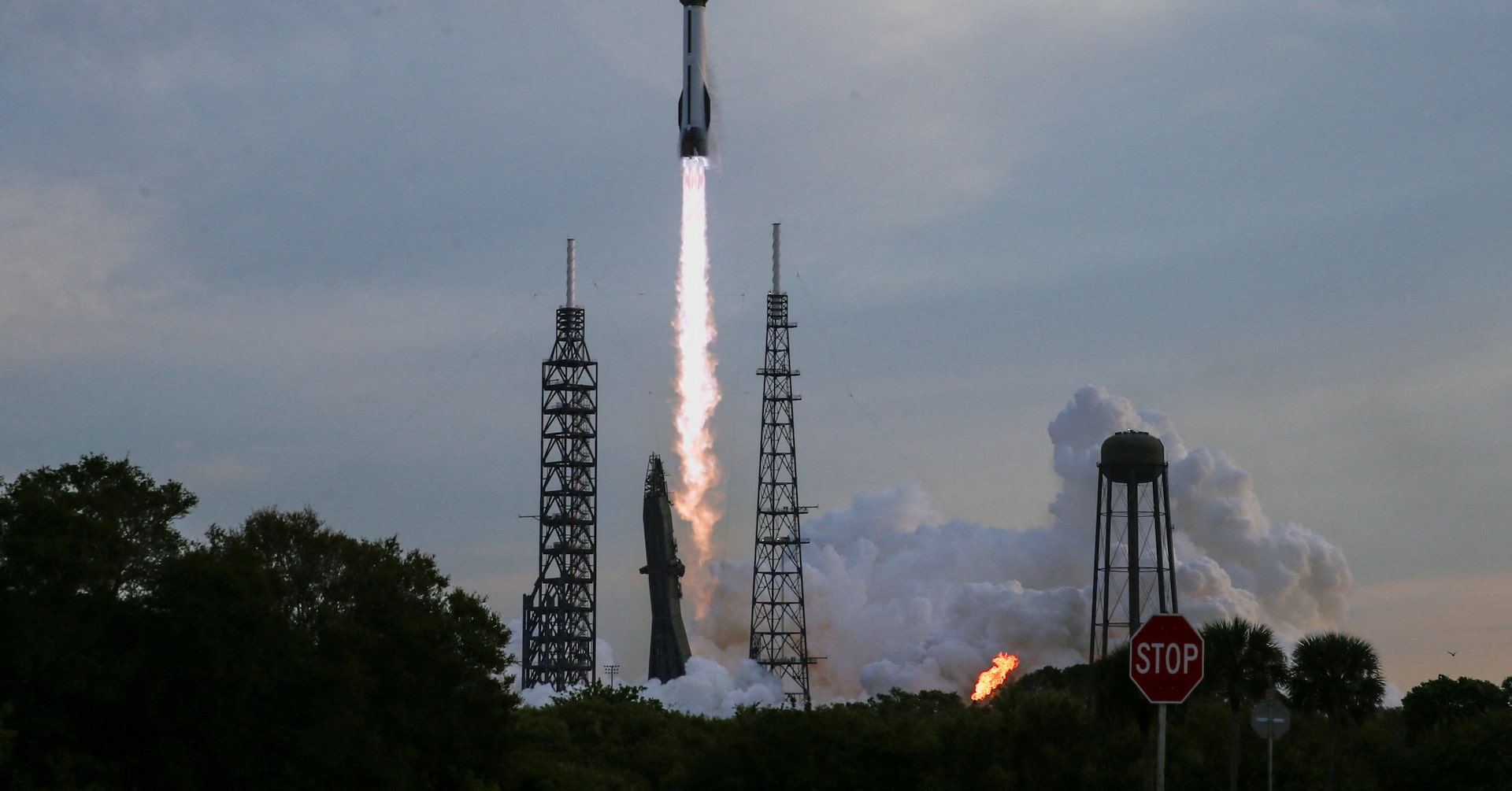
The Federal Aviation Administration (FAA) has grounded Blue Origin's New Glenn rocket following a malfunction during its third flight on April 19, 2026.
The Federal Aviation Administration (FAA) has grounded Blue Origin's New Glenn rocket following a malfunction during its third flight on April 19, 2026. An upper-stage engine failure left a customer satellite in an unusable orbit, leading to the spacecraft's destruction upon atmospheric re-entry. The FAA has ordered a formal mishap investigation before the heavy-lift vehicle is permitted to fly again.
The Details
The incident occurred during the NG-3 mission, which was Blue Origin's first commercial flight carrying a paying customer. While the reusable first-stage booster, named 'Never Tell Me the Odds,' successfully launched and landed for the second time—marking the company's first orbital-class booster reflight—the mission failed in its final stages. Data indicates that one of the two BE-3U engines on the upper stage failed to produce sufficient thrust during the second circularization burn.
This propulsion failure resulted in the payload, AST SpaceMobile's BlueBird 7 communications satellite, being placed into an orbit with a perigee of approximately 95 miles. This was significantly lower than the intended target altitude of 285 miles. Because the satellite was positioned too low for its own onboard thrusters to compensate, it was unable to sustain operations.
AST SpaceMobile confirmed the loss of the asset, which re-entered the Earth's atmosphere on Monday, April 20. Astrophysicist Jonathan McDowell noted that the satellite likely burned up harmlessly during re-entry. The BlueBird 7 was a six-ton spacecraft designed to deploy a 2,400-square-foot antenna for direct-to-smartphone cellular broadband.
Blue Origin CEO Dave Limp acknowledged the failure on social media, stating that early data suggests the BE-3U engine did not produce enough thrust. He noted that while the booster recovery was nominal, the company failed to deliver the mission results expected by the customer. The FAA has notified NASA, the NTSB, and the U.S. Space Force regarding the mishap classification.
Context
The New Glenn is a 321-foot-tall heavy-lift vehicle developed by Jeff Bezos' Blue Origin. The company has recently pivoted its focus, announcing in January 2026 that it would halt its space tourism operations for at least two years to concentrate on commercial launch services and the development of a lunar lander for NASA.
This grounding is not the first for the New Glenn. The vehicle was previously grounded for two and a half months after its debut flight in January 2025 when the first-stage booster failed to land. However, the second flight in November 2025 was successful, delivering two NASA probes toward Mars.
Blue Origin is entering a highly competitive market for satellite broadband. AST SpaceMobile is competing against established services like SpaceX's Starlink, which already boasts over 10 million active users and a constellation of 10,000 satellites. Blue Origin also intends to enter this space with its own TerraWave project, which aims to launch thousands of low-Earth orbit satellites.
What's Next
Blue Origin must now conduct a comprehensive investigation under FAA oversight. To resume flight operations, the company must submit a final report, obtain FAA approval for corrective actions, and prove that the New Glenn poses no hazard to public safety.
Despite the loss, AST SpaceMobile expects the cost of the BlueBird 7 to be covered by insurance. The company has signaled that it will not slow its expansion, intending to maintain a launch cadence of one orbital launch every one to two months throughout 2026 using a variety of launch providers.
For Blue Origin, the investigation is critical to meeting its 2026 goals. CEO Dave Limp had previously expressed a desire to launch the New Glenn at least eight times this year, and the company has been cleared by the Space Force for up to 12 launches annually.
Never Miss a Signal
Get the latest breaking news and daily briefings from Zero Signal News directly to your inbox.