
Former Hostage Envoy Warns Iran May Use Detained Americans as 'Sweetener' in Nuclear Talks
Zero Signal Staff
Published April 18, 2026 at 4:55 AM ET · 18 hours ago
Fox News
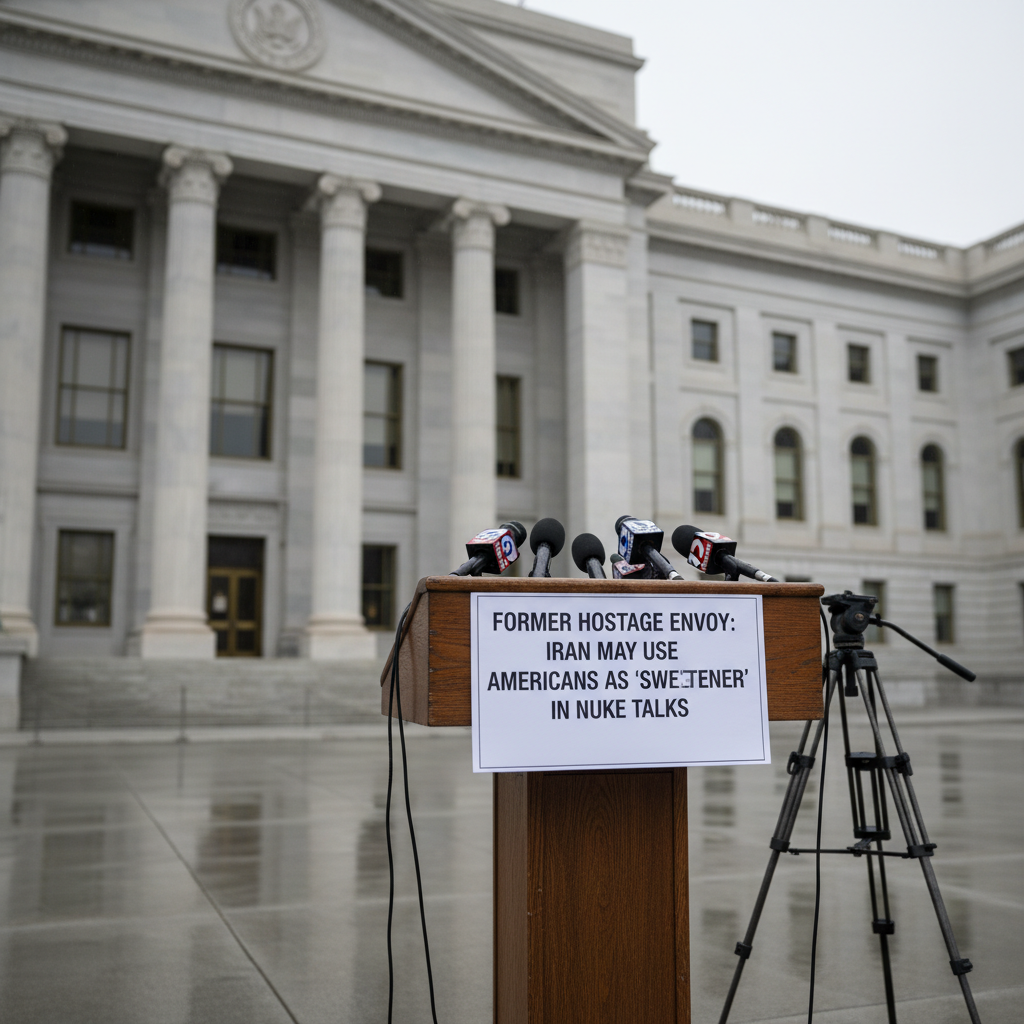
Roger Carstens, the former U.S. Special Presidential Envoy for Hostage Affairs, has warned that Iran may use at least six detained American citizens as leverage, or a 'sweetener,' during ongoing nuclear negotiations.
Roger Carstens, the former U.S. Special Presidential Envoy for Hostage Affairs, has warned that Iran may use at least six detained American citizens as leverage, or a 'sweetener,' during ongoing nuclear negotiations. Carstens cautioned that Iranian negotiators are uniquely untrustworthy, urging the Trump administration to make the release of these prisoners a formal priority. The warning comes as the U.S. and Iran struggle to reach a permanent deal following a period of active conflict.
The Details
In a recent interview with Fox News, Carstens stated that the six Americans held in Iranian prisons are being kept 'healthy and ready' to be traded at the negotiating table. He described the nature of Iranian diplomacy as volatile, asserting that 'you cannot trust the Iranians up until the last second.' Carstens compared Iran unfavorably to other adversarial regimes, including Russia, China, and the Taliban, claiming that those groups are more likely to adhere to handshake deals than Tehran. Among the detainees are Kamran Hekmati, 61, a Jewish Iranian-American who has been imprisoned for roughly 11 months following a visit to Israel. Hekmati is battling bladder cancer and requires ongoing medical care, raising urgent concerns about his survival in Tehran's Evin Prison. Also detained is Reza Valizadeh, 49, a journalist for the U.S.-funded Radio Farda. Valizadeh was arrested in September 2024 while visiting family; he was subsequently sentenced to 10 years in prison after being accused of collaborating with the U.S. government. A third identified captive, Afarin Mohajer, a California resident, was arrested in September and charged with spreading critical propaganda. While Carstens focused on six confirmed prisoners, the organization United Against Nuclear Iran (UANI) tracks a broader list of 13 individuals in Iranian captivity, including those under house arrest or travel bans. Secretary of State Marco Rubio has already designated Iran as a 'state sponsor of wrongful detention' as of February 2026, noting that Tehran uses innocent citizens as political leverage. This designation reflects the systemic use of 'hostage diplomacy' to extract concessions from Washington. The current diplomatic friction is underscored by the failure of a 21-hour marathon session in Islamabad on April 11-12, 2026. That meeting, led by Vice President JD Vance and Special Envoy Steve Witkoff, ended without an agreement. While the U.S. sought narrow terms regarding the Strait of Hormuz and nuclear limits, Iran demanded sovereignty over the Strait and the release of $27 billion in frozen assets. Reports indicate that the plight of the detainees was treated as a secondary matter during these talks.
Context
The United States and Israel launched a military campaign against Iran on February 28, 2026, targeting nuclear installations and missile capabilities. Although a fragile ceasefire is currently in effect, the geopolitical environment remains tense. Historically, the U.S. has struggled to balance the release of prisoners with the enforcement of sanctions. In 2023, the Biden administration secured the release of five Americans in exchange for $6 billion in frozen assets—a precedent that critics argue encourages further detentions. President Trump has made the return of Americans a hallmark of his foreign policy, with White House spokesperson Anna Kelly noting he has brought home over 100 individuals globally since taking office. However, the current framework for peace talks with Iran is focused primarily on security and economics rather than humanitarian returns.
What's Next
President Trump has publicly stated he expects a permanent deal with Iran to be reached within days, though future meetings have not yet been formally scheduled. The central question for the administration is whether to adopt Roger Carstens' suggestion to make the release of hostages a 'fifth objective' alongside existing security goals. A coalition of pro-Israel and human rights groups, including the American Jewish Committee and the James W. Foley Legacy Foundation, is now lobbying the White House to make the return of captives an 'urgent national priority.' The outcome of the next round of talks will likely determine whether these six Americans remain bargaining chips or are prioritized as citizens to be recovered.
Never Miss a Signal
Get the latest breaking news and daily briefings from Zero Signal News directly to your inbox.