
Georgia Divided Over Supreme Court Voting-Rights Ruling as Secretary of State Race Heats Up and Wildfire Risk Escalates
Zero Signal Staff
Published April 30, 2026 at 5:03 AM ET · 150 days ago
Georgia Public Broadcasting / Georgia Recorder / Atlanta News First / Atlanta Journal-Constitution / WTOC / CNN / Savannah Morning News / Georgia Forestry Commission
Georgia is navigating three intersecting political and public-safety pressures this week: a sharply divided reaction to the U.S.
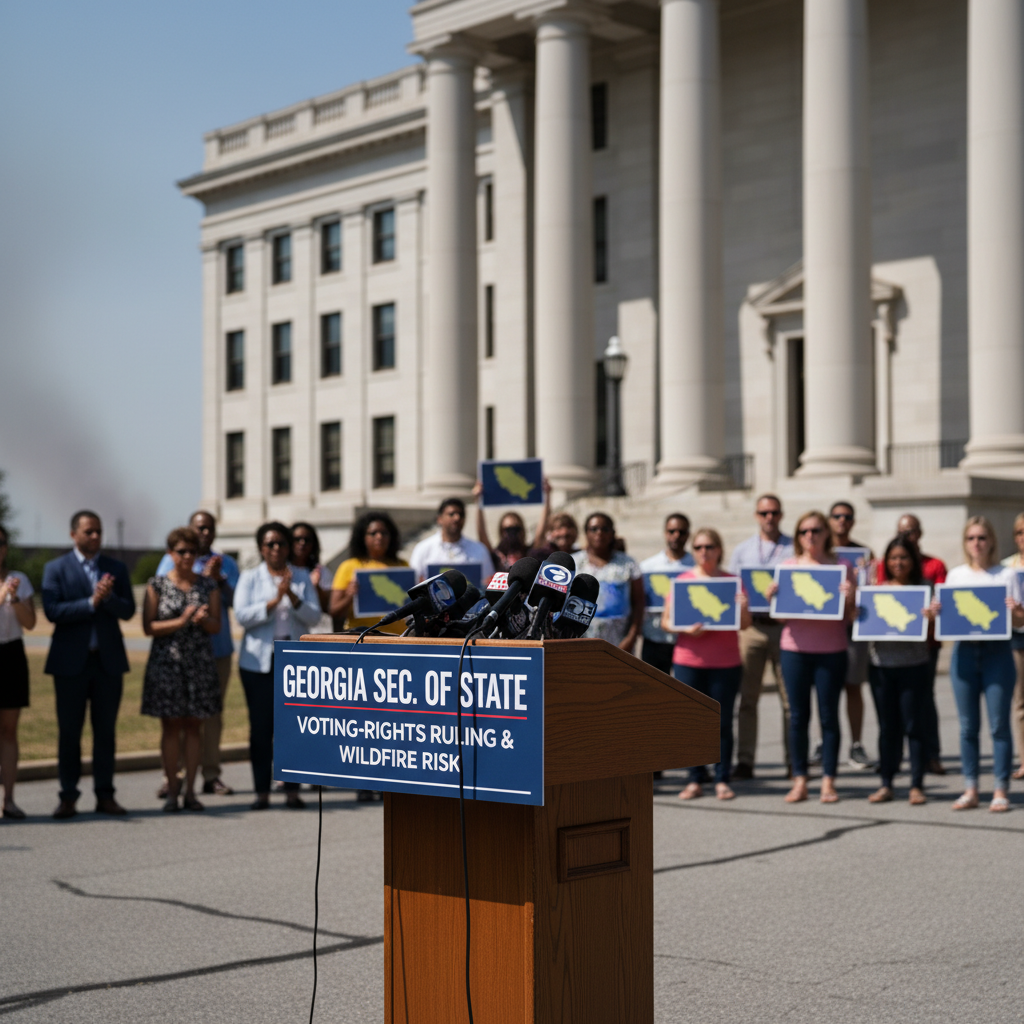
Georgia is navigating three intersecting political and public-safety pressures this week: a sharply divided reaction to the U.S. Supreme Court's April 29 ruling weakening a core Voting Rights Act protection, a late-stage debate among candidates competing to become the state's next secretary of state with early voting already underway, and a surge in illegal burning violations as an extreme drought grips the state's southern counties.
The Details
The Supreme Court's April 29 decision in Louisiana v. Callais drew immediate condemnation from prominent Georgia Democrats. The ruling makes future racial-gerrymandering challenges harder by requiring plaintiffs to prove intentional racial discrimination — a significantly higher legal bar than prior precedent, according to the Georgia Recorder and CNN.
Senator Raphael Warnock called the decision a backward step for civil rights. 'Make no mistake, this ruling harkens back to the darkest days of the Jim Crow era, when Black Americans were kept out of rooms of power,' Warnock said, as quoted by the Georgia Recorder. The senator's remarks were among the sharpest Democratic responses to emerge from Georgia in the hours following the ruling.
Prominent Georgia Republicans, meanwhile, engaged in discussion about potential redistricting implications of the decision, according to Georgia Public Broadcasting. The reaction followed familiar party-line contours, with Democrats framing the ruling as a setback for minority representation and Republicans focusing on what the changed legal standard could mean for the state's congressional map. GPB reported that the divide was sharp and immediate in the hours after the court's decision was handed down.
One day earlier, on April 28, the Atlanta Press Club hosted candidates competing in Georgia's secretary of state and attorney general races as part of its Loudermilk-Young debate series, according to Atlanta News First. The event also featured candidates for the Public Service Commission. Both Republican and Democratic contenders used the forum to make their final pitches on election administration, voting access, and related policy priorities.
The timing was significant. Early voting in the May 19 primary opened April 27-28, meaning ballots were already being cast as the debate aired, the Atlanta Journal-Constitution reported. The AJC also reported that the secretary of state race is shadowed by a looming vote-counting problem the state will need to resolve — a point that added urgency to the policy positions candidates outlined on stage.
In South Georgia, a separate but worsening crisis is stretching local fire departments. Chatham County fire authorities said they have responded to roughly 40 to 50 illegal burn pile violations since Georgia's statewide burn ban took effect on April 22, according to WTOC. Chatham County fire chief James Vickers described the conditions in direct terms. 'Very, very, very dangerous situation that we're in,' Vickers told WTOC. The volume of violations — nearly one a day on average since the ban began — underscores the difficulty of enforcement during an active drought emergency.
Context
The Supreme Court ruling stems from Louisiana v. Callais, a case with consequences that extend beyond Georgia. By raising the evidentiary threshold to intentional racial discrimination, the decision limits the kind of circumstantial and statistical evidence that has historically supported racial-gerrymandering claims across Southern states, the Georgia Recorder and CNN reported. Georgia Republicans referenced the ruling in early discussions about future redistricting, according to Georgia Public Broadcasting, though those conversations remained preliminary as of April 29.
Georgia's emergency wildfire measures are substantial. The burn ban covers 91 southern counties and runs through May 22. The state has also activated statewide Level 1 drought response measures, according to WTOC, the Savannah Morning News, and the Georgia Forestry Commission. Extreme drought conditions have elevated wildfire risk across the region, making compliance with the burn ban a public-safety priority for fire officials already responding to a high volume of violations.
What's Next
Georgia's May 19 primary will determine which candidates advance in the secretary of state, attorney general, and Public Service Commission races. Early voting is already underway, according to the Atlanta Journal-Constitution, and the Atlanta Press Club debate was among the last major public forums before election day for candidates to address voters on election administration issues.
The burn ban covering 91 southern counties remains in effect through May 22, according to WTOC and the Georgia Forestry Commission. Chatham County fire officials are continuing to respond to illegal burn violations, and drought conditions across South Georgia show no sign of easing in the near term.
Never Miss a Signal
Get the latest breaking news and daily briefings from Zero Signal News directly to your inbox.