
Hot 100 Hits Have Grown Moodier, Slower and More Emotionally Distant Over Five Years, Billboard Reports
Zero Signal Staff
Published April 30, 2026 at 11:16 AM ET · 149 days ago
Billboard
The songs topping America's most-watched singles chart have shifted in a measurable direction over the past five years — darker in tone, slower in tempo and increasingly defined by cynicism, anger and nostalgia.
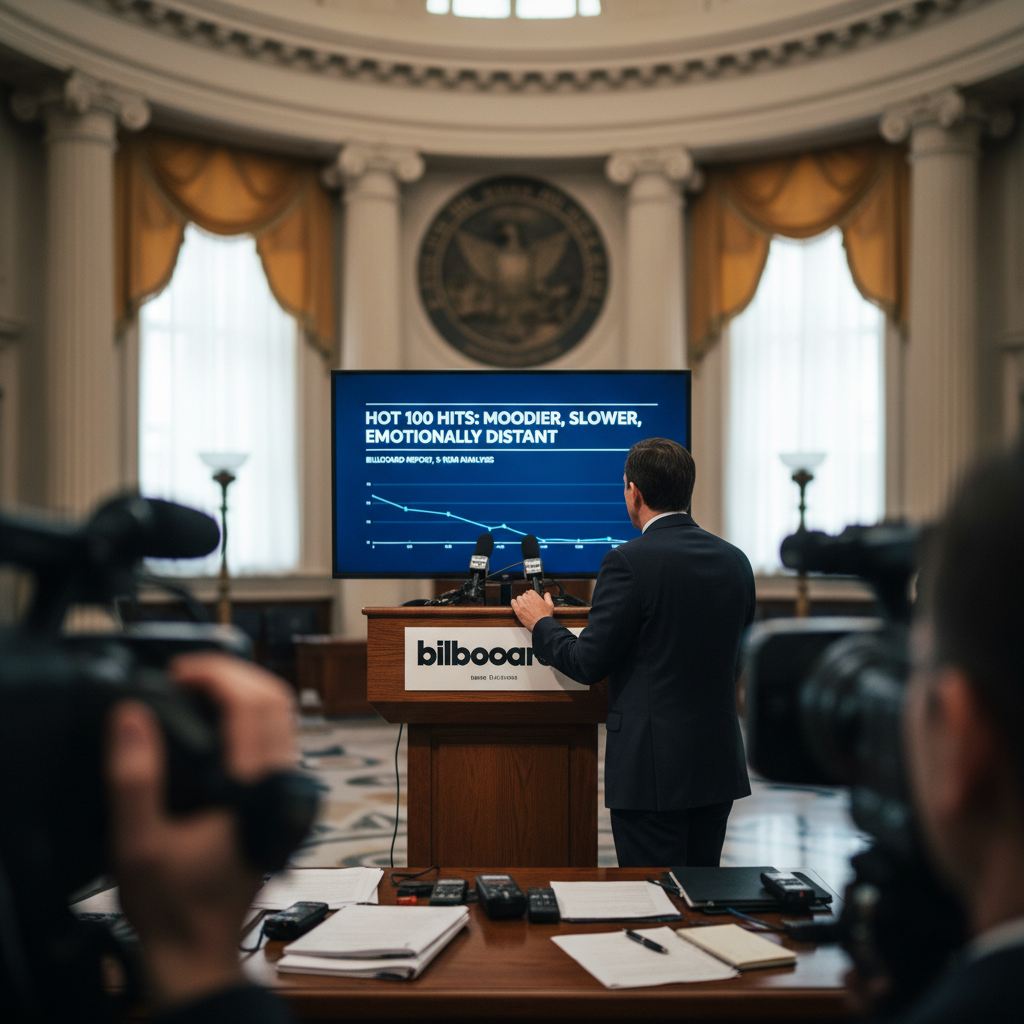
The songs topping America's most-watched singles chart have shifted in a measurable direction over the past five years — darker in tone, slower in tempo and increasingly defined by cynicism, anger and nostalgia. That is the finding of analytics firm ChartCipher's 2025 Hot 100 trend report, as summarized by Billboard on April 30, 2026.
The Details
ChartCipher, which describes itself as an AI-powered song analytics platform that extracts compositional, lyrical and sonic data from songs, tracked Hot 100 entries across the period from 2021 through 2025. According to Billboard's summary of the report, the share of Hot 100 songs coded as cynical climbed from 59 percent in 2021 to 70 percent in 2025. Anger rose from 26 percent to 36 percent over the same window. Nostalgia increased from 23 percent to 33 percent.
ChartCipher described the pattern in unambiguous terms. "The common lyrical moods that increased the most over the five-year period all point in the same emotional direction," the firm stated, as quoted by Billboard.
The mood shift was not confined to lyrics. Billboard's summary of the ChartCipher report found a parallel move toward slower production across the five-year period. Songs running at under 79 beats per minute made up 35 percent of Hot 100 entries in 2021; by 2025, that share had risen to 44 percent. Songs in the 80-to-99 BPM range moved the other way — falling from 33 percent of the chart in 2021 to 24 percent in 2025. Darker sonic timbres remained dominant throughout. "The chart as a whole moved toward lower-energy production," ChartCipher stated, as quoted by Billboard.
ChartCipher summarized the combined effect in its report. "Taken alongside the shift toward slower, less kinetic production, as well as the continued dominance of darker timbres, the Hot 100 is increasingly being defined by a moodier, more distant emotional tone," the firm said, as quoted by Billboard.
Not every metric shifted toward the darker end. Love remained the most common lyrical theme on the Hot 100 across all five years of the study, appearing in between 42 percent and 51 percent of charting songs in any given year, according to Billboard's summary of the ChartCipher data. The dominance of romantic themes has been consistent enough that a July 2024 cross-post between ChartCipher and Billboard on the chart's component charts found love songs leading the lyrical-theme mix in 2023 as well — a finding that aligns with the 2025 report's broader claim that the theme remained stable at the top even as the emotional register shifted downward around it.
Genre composition on the Hot 100 also changed considerably during the period, according to Billboard's summary. Hip-hop and rap remained the largest primary genre represented among chart hits across all five years, but its share contracted significantly — falling from 47 percent of Hot 100 entries in 2021 to 29 percent in 2025. Rock moved in the opposite direction, more than doubling its share from 10 percent in 2021 to 22 percent in 2025. Billboard reported these figures from the same ChartCipher 2025 Hot 100 trend report.
ChartCipher's own prior analyses offer additional context for those patterns. An October 2023 genre breakdown of the Hot 100 published by ChartCipher found hip-hop still led the chart at that point despite a multi-year decline, while rock and country were gaining share — a trajectory that appears to have continued into 2025 based on the new report. A separate ChartCipher analysis published in April 2024, focused on the Radio Songs chart rather than the Hot 100, found sub-79-BPM songs at their highest share in more than a decade, suggesting the slower-song trend was visible across adjacent charts before the 2025 Hot 100 data was compiled.
Context
ChartCipher has been publishing Billboard chart analyses for several years, building a methodology around AI-assisted extraction of compositional, lyrical and sonic properties from songs. Its prior work on the Hot 100 includes a 2023 timbre analysis — also summarized by Billboard — that documented darker timbres tied in part to hip-hop's sustained chart presence. The 2025 trend report extends that work to cover mood, tempo and genre simultaneously across a five-year window.
It is worth noting the scope of what the data measures. ChartCipher's figures describe what reached the Hot 100 — the broad commercial chart — not what was released or what critics elevated. The findings reflect aggregate listener behavior as captured through chart performance, not a sample of new releases or a curated selection. The distinction matters when reading the mood percentages: a chart that is 70 percent coded as cynical does not mean 70 percent of popular music carries that tone; it means 70 percent of the songs that made the Hot 100 in 2025 did so according to ChartCipher's analytical categories.
The exact 2025 ChartCipher trend report does not appear to be publicly posted in full. Billboard is the primary outlet publishing the specific 2025 percentages cited in this article. Corroborating data points — the genre decline of hip-hop, the rise of rock, the slower tempos — come from ChartCipher's prior public analyses, which use the same methodology applied to adjacent charts and earlier years.
What's Next
Billboard did not report any scheduled follow-up release of the full 2025 ChartCipher report to a public channel, and ChartCipher has not announced a release date for the complete data. The 2025 trend analysis is the most recent in ChartCipher's ongoing series of Hot 100 breakdowns. Whether the mood and tempo trends documented for the 2021-2025 window continue into 2026 will be a question for subsequent reports.
Never Miss a Signal
Get the latest breaking news and daily briefings from Zero Signal News directly to your inbox.