
Humanoid Robot Trial Puts Recycling Labour Strain On The Sorting Line
Zero Signal Staff
Published May 4, 2026 at 11:01 PM ET · 160 days ago
BBC News
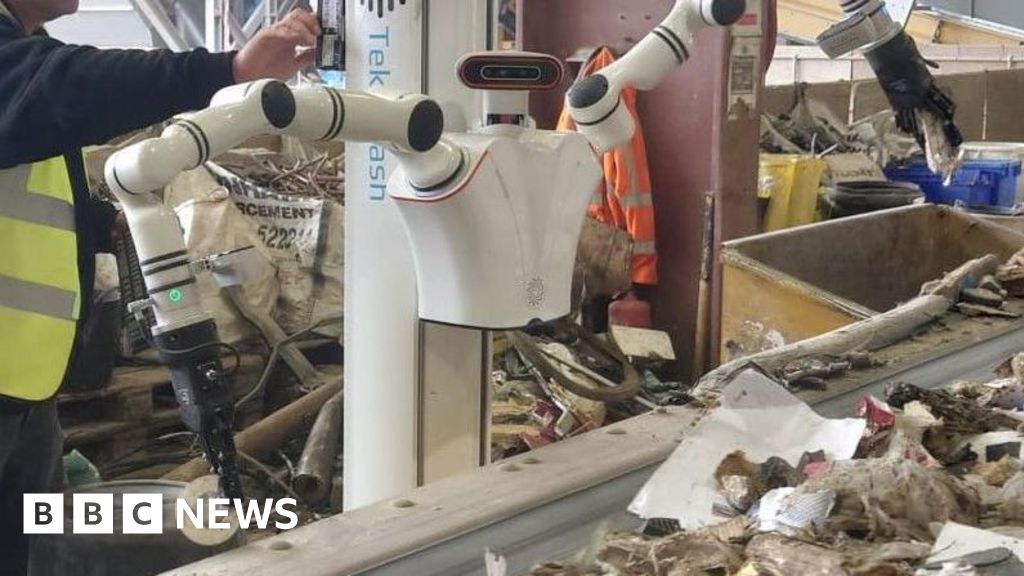
A recycling plant in Rainham, east London, is testing a humanoid robot on its sorting line as operators confront difficult manual work and high staff turnover, according to BBC News and trade coverage of the pilot.
A recycling plant in Rainham, east London, is testing a humanoid robot on its sorting line as operators confront difficult manual work and high staff turnover, according to BBC News and trade coverage of the pilot. Sharp Group's facility processes up to 280,000 tonnes of mixed recycling a year with 24 agency workers on fast conveyor lines, BBC News reported.
The Details
BBC News reported that Sharp Group's annual staff turnover is about 40%, with line supervisor Ken Dordoy saying many pickers are not able to keep up with the work. Dordoy told BBC News, "The belt is moving all the time, you're constantly picking. I go through a lot of pickers because they just aren't up to the job."
Sharp Group and TeknTrash are piloting ALPHA, the Automated Litter Processing Humanoid Assistant, at the Rainham facility, according to Sharp Skips. The companies are using frontline workers in Meta Quest 3 headsets to capture movement data that can be used to train the robot for recycling-line tasks, Sharp Skips said.
Recycling Product News reported that the Rainham site handles about 2,800 tonnes of waste per week. The same trade report said collected motion data is being used to train ALPHA to take on repetitive, unsanitary or dangerous sorting tasks.
BBC News said ALPHA was built by China's RealMan Robotics and is being adapted for live recycling operations by British firm TeknTrash Robotics. BBC News also reported that TeknTrash argues a humanoid system can be placed into existing plants without redesigning machinery.
Chelsea Sharp, described in the brief as a director and plant finance director at Sharp Group, told BBC News the company's interest is tied to the limits of human work on the line. "The attraction of a humanoid is that you can put it here and it stays here. It will pick all day, 24 hours a day, seven days a week. It's not going to apply for a holiday, it's not going to have a sick day," Sharp said.
Al Costa, founder and CEO of TeknTrash Robotics, is leading the ALPHA humanoid robot pilot for waste sorting, according to BBC News and Recycling Product News. In a statement carried by Recycling Product News, Costa said, "Our goal is to build a smarter, more sustainable future where waste isn't just managed — it's understood."
The pilot was publicly launched by TeknTrash and Sharp Group on April 28, 2025, according to UK Tech News. Recycling Product News reported on May 26, 2025, that frontline workers were using VR headsets to train ALPHA on live waste-sorting movements, and BBC News visited the Rainham plant on May 5, 2026, to report on the labour strain, 40% turnover and the still-in-training humanoid robot on the sorting line.
Context
The Rainham project is being presented as a co-development effort rather than a finished deployment, according to UK Tech News and Sharp Group materials. UK Tech News reported that Sharp Group says its Rainham site is being used as a co-development hub where robot training and day-to-day waste operations run in parallel.
The throughput figures in the reporting describe the same plant from different angles. BBC News reported capacity of up to 280,000 tonnes of mixed recycling a year, while Recycling Product News reported about 2,800 tonnes of waste per week; the fact brief says those annual and weekly descriptions are not a material conflict.
BBC News placed the ALPHA trial alongside other automation approaches in the sector, including AMP's AI sorting systems and Glacier's robotic arms. The brief says BBC used those examples to show that the Rainham trial is part of a wider move away from recycling lines that depend entirely on human sorting.
Recycling Product News reported that the UK waste and recycling sector has above-average workplace health and injury risk, and the fact brief identifies that risk as a key reason operators are exploring robotic sorting systems. That hazard framing is attributed to trade coverage in the brief and was not independently re-verified from a Health and Safety Executive primary page during the research session.
What's Next
TeknTrash has said it wants to scale the same cloud-connected humanoid sorting approach across 1,000 plants in Europe once the Rainham pilot matures, according to UK Tech News. The brief says that claim should be treated as a TeknTrash and trade-coverage goal, not as an achieved deployment.
TeknTrash says its HoloLab and cloud-based training stack are designed to feed large volumes of operational data into the humanoid model before wider deployment, according to BBC News and TeknTrash materials summarized in the brief. For now, the sourced record shows a Rainham pilot in which human workers are still capturing live movement data while ALPHA remains in training.
BBC News reported that the plant's labour strain, turnover and robot trial were all visible in its May 5, 2026, visit to the site. The next step identified in the brief is continued maturation of the Rainham pilot before any wider European rollout described by TeknTrash and trade coverage.
Never Miss a Signal
Get the latest breaking news and daily briefings from Zero Signal News directly to your inbox.