
Iran Reopens Strait of Hormuz Under Restrictions as US Maintains Naval Blockade
Zero Signal Staff
Published April 17, 2026 at 7:33 PM ET · 1 day ago
The Guardian; AP News
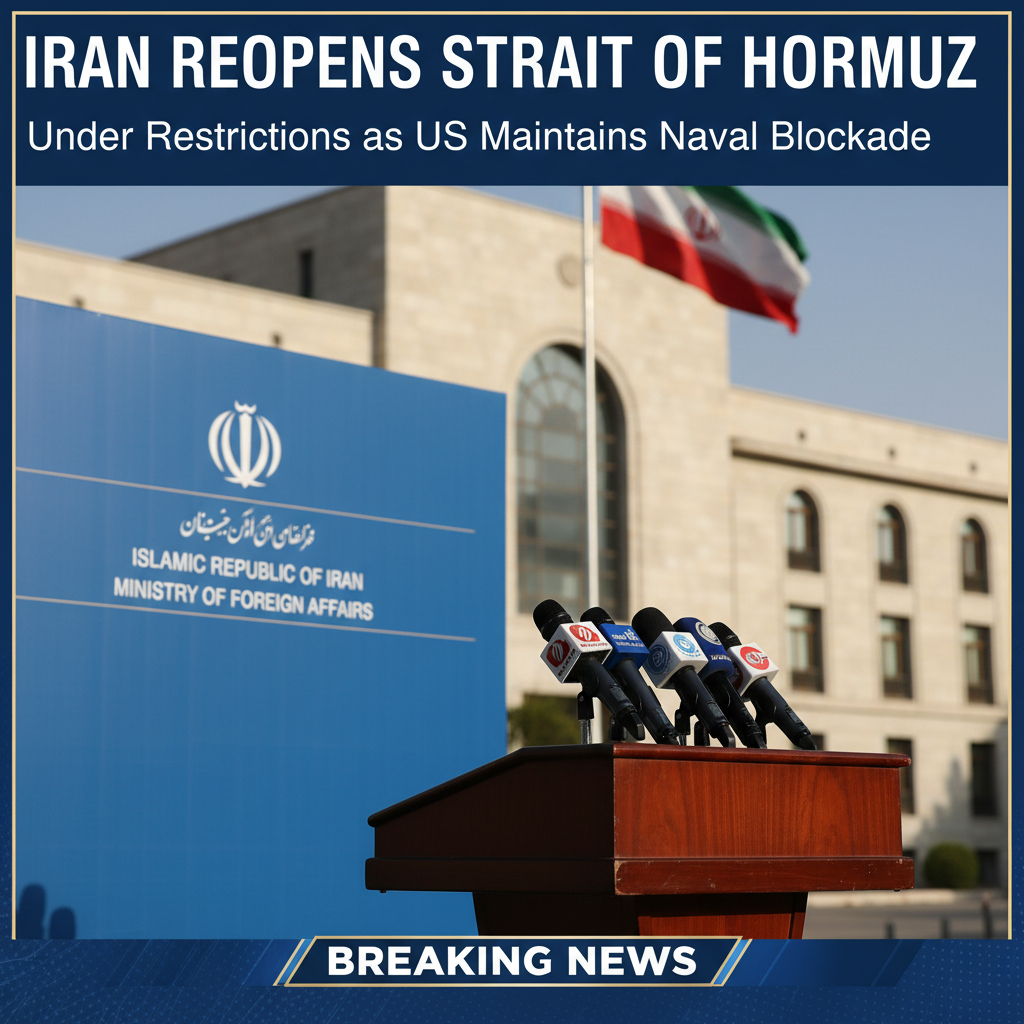
Iran has announced the reopening of the Strait of Hormuz to commercial traffic for the remainder of the current ceasefire period. However, the move is tempered by strict routing requirements and a continuing US naval blockade of Iranian ports.
Iran has announced the reopening of the Strait of Hormuz to commercial traffic for the remainder of the current ceasefire period. However, the move is tempered by strict routing requirements and a continuing US naval blockade of Iranian ports. The announcement triggered a sharp decline in global oil prices and a surge in US stock markets.
The Details
Iranian Foreign Minister Abbas Araghchi stated that passage for all commercial vessels is 'completely open,' but shipping analysts and data from Kpler indicate the reopening is qualified. Vessels are required to follow a narrow corridor near the island of Larak and the Iranian coastline, with movement remaining subject to Iranian approval.
Simultaneously, US President Donald Trump announced via Truth Social that the US naval blockade on Iranian ports and ships will remain in full force. Trump stated the blockade will persist until a 'transaction' with Iran—specifically regarding the war and its nuclear program—is '100% complete.'
Market reactions were immediate, with Brent crude dropping nearly 10% to below $90 a barrel and US benchmark crude falling 9.4% to $82.59. The S&P 500 rose 1.2%, reaching a new all-time high on the news.
Maritime operators have responded with caution. While Maersk welcomed the opportunity, the company noted that the announcement does not yet provide 'full maritime certainty.' Bimco and the US Navy have warned that the status of mine threats in parts of the strait remains 'not fully understood,' advising ships to consider avoiding the area.
Internal contradictions have also emerged within Iran. Semi-official news agencies Fars and Mehr suggested that Foreign Minister Araghchi's announcement required further clarification and the approval of the Supreme Leader. One unnamed Iranian official threatened to re-close the strait if the US blockade continues.
Context
The Strait of Hormuz is one of the world's most critical energy chokepoints, handling approximately one-fifth of the global oil supply. The current tension is part of a larger conflict that began on February 28, 2026, and has resulted in at least 3,000 deaths in Iran and over 2,290 in Lebanon.
A two-week ceasefire brokered by Pakistan began on April 7 and is scheduled to expire on April 22. The recent US blockade was implemented after Iran restricted traffic in the strait, which Iran claimed was a reciprocal response to breaches of the ceasefire in Lebanon.
Diplomatically, Pakistan's army chief Asim Munir has been conducting high-level meetings in Tehran with President Pezeshkian and other IRGC leaders to mediate the crisis. Meanwhile, France and the UK are organizing a 'Maritime Freedom of Navigation Initiative' in Paris, involving 30 to 40 countries, though the US is not participating in these talks.
What's Next
Attention now turns to a potential second round of US-Iran talks, suggested by President Trump to take place this weekend, possibly in Islamabad. A central point of contention remains Iran's nuclear stockpile; Trump claims Iran has agreed to surrender 440.9kg of 60% enriched uranium, though no Iranian official has confirmed this agreement.
In Lebanon, a 10-day ceasefire requested by the US is in effect. While Israeli Prime Minister Benjamin Netanyahu stated the campaign against Hezbollah is not yet finished, the US has prohibited Israel from conducting further offensive bombing in the region.
The world awaits the April 22 expiration of the Pakistan-brokered truce, as the lack of independent verification regarding Iran's commitment to keep the strait open leaves global energy markets vulnerable to further volatility.
Never Miss a Signal
Get the latest breaking news and daily briefings from Zero Signal News directly to your inbox.