
Legislative Deadline May Pressure Trump Administration Toward Iran De-escalation
Zero Signal Staff
Published April 22, 2026 at 4:54 PM ET · 157 days ago
NY Times
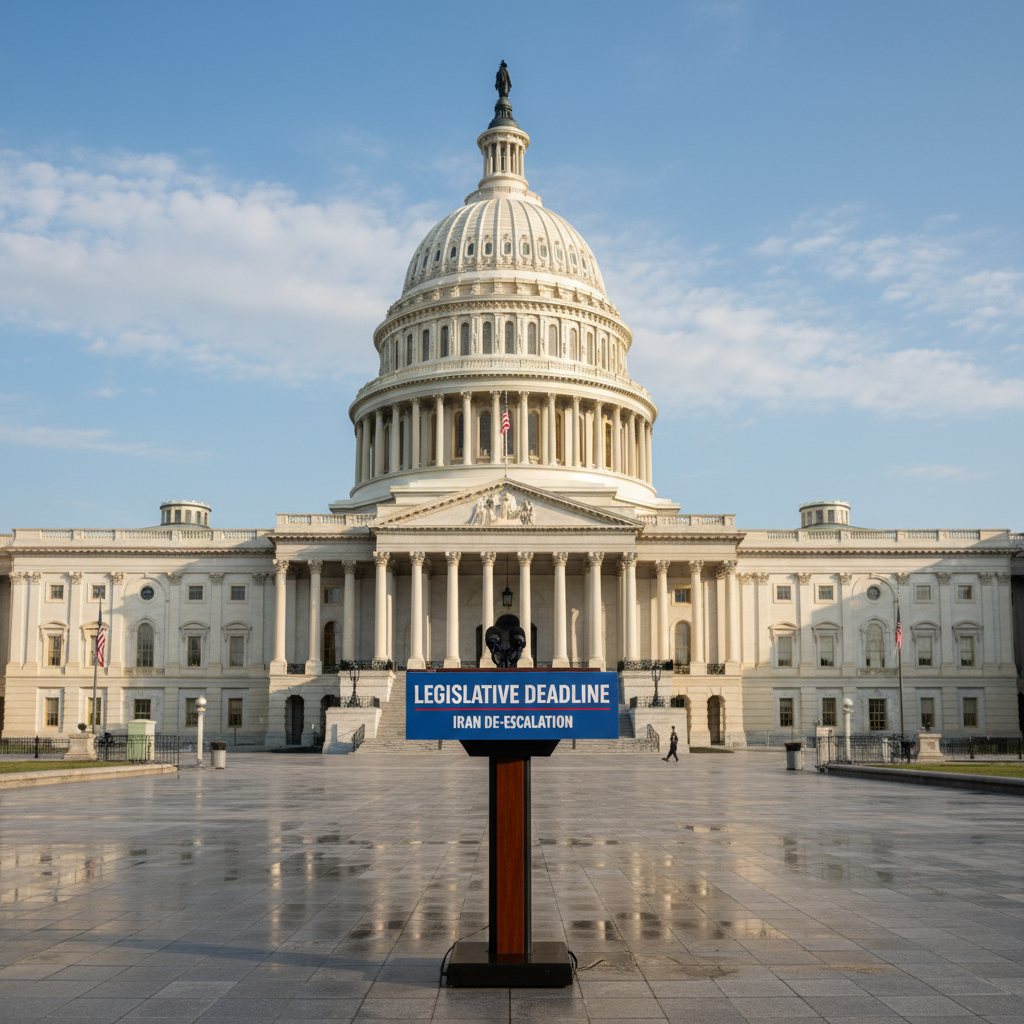
The Trump administration faces a tightening timeline as a 60-day statutory deadline under the War Powers Resolution looms, potentially forcing a decision on the scale of U.S. military involvement in the Iran conflict.
The Trump administration faces a tightening timeline as a 60-day statutory deadline under the War Powers Resolution looms, potentially forcing a decision on the scale of U.S. military involvement in the Iran conflict. This window creates a critical juncture for the White House to either secure congressional authorization or wind down active hostilities. The pressure mounts as diplomatic channels and military posture clash over the long-term strategy for regional stability.
The Details
The 60-day clock is a cornerstone of the War Powers Resolution of 1973, which prohibits the U.S. president from keeping armed forces in hostilities outside the U.S. for more than 60 days without a declaration of war or a specific statutory authorization from Congress. In the current context of tensions with Iran, the administration has operated under the premise of self-defense and national security interests, but the lack of formal congressional approval is becoming a point of contention.
Lawmakers from both sides of the aisle have signaled that they are monitoring the deadline closely. Some argue that the administration's current posture exceeds the 'limited engagement' typically allowed under emergency powers. The tension is compounded by the strategic goal of ending the 'Iran War'—a term increasingly used by critics to describe the prolonged cycle of proxy conflicts and direct skirmishes.
Inside the administration, there is a divide between those favoring a 'maximum pressure' campaign and those advocating for a negotiated settlement. The 60-day limit serves as a catalyst for this internal debate, as failing to obtain congressional support could lead to a constitutional crisis or a forced withdrawal that might be perceived as a sign of weakness.
Military analysts suggest that the administration may attempt to redefine 'hostilities' to circumvent the deadline. However, the transparency of modern conflict and the intensity of recent engagements make this a difficult legal argument to maintain.
Meanwhile, the State Department is reportedly exploring back-channel communications to ensure that any wind-down of activity does not inadvertently trigger an escalation from Tehran. The goal is to transition from a state of active conflict to a managed deterrence model without relinquishing strategic advantages.
Context
The War Powers Resolution was passed in the wake of the Vietnam War to check the executive branch's power to commit U.S. forces to overseas conflicts without legislative consent. For decades, presidents have interpreted the act narrowly, often claiming that limited operations do not constitute 'hostilities.'
The conflict with Iran has evolved over several years, moving from economic sanctions and maritime incidents to more direct confrontations involving regional proxies. The Trump administration's approach has historically focused on dismantling Iran's nuclear capabilities and limiting its regional influence, often through aggressive posturing and targeted strikes.
Congress has historically been hesitant to grant a 'blank check' for a full-scale war in the Middle East, reflecting a broader public exhaustion with protracted foreign interventions. This legislative environment makes the 60-day deadline a potent tool for forcing a strategic pivot.
What's Next
In the coming weeks, the White House is expected to present a formal justification for its current operations to the House and Senate Foreign Relations Committees. This presentation will be a key indicator of whether the administration intends to seek a formal authorization for use of military force (AUMF) or if it is preparing a roadmap for a gradual exit.
Simultaneously, observers will be watching for any signs of a diplomatic breakthrough. A negotiated ceasefire or a new framework for security guarantees could resolve the legal tension over the War Powers Act by removing the 'hostilities' that the act seeks to regulate.
If no agreement is reached and Congress refuses to authorize further action, the administration may be forced to either defy the law—leading to a protracted legal battle—or significantly reduce the U.S. military footprint in the region by the deadline.
Never Miss a Signal
Get the latest breaking news and daily briefings from Zero Signal News directly to your inbox.