
MIT Engineers 3D-Print Structural Home Frames From Recycled Plastic
Zero Signal Staff
Published April 22, 2026 at 3:53 AM ET · 158 days ago
MIT News
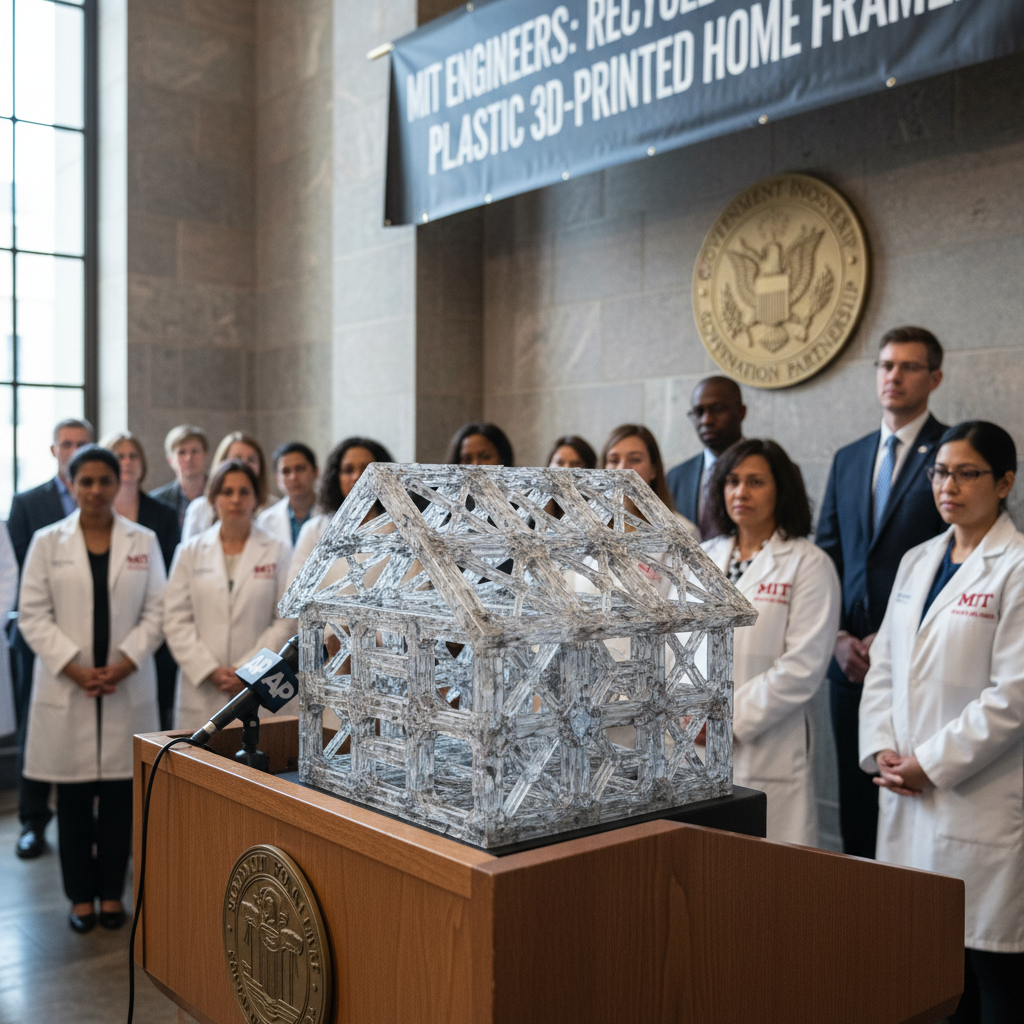
Engineers at MIT have successfully 3D-printed construction-grade floor trusses using a composite of recycled PET polymers and glass fibers. The resulting structures far exceeded U.S.
Engineers at MIT have successfully 3D-printed construction-grade floor trusses using a composite of recycled PET polymers and glass fibers. The resulting structures far exceeded U.S. building standards, suggesting a viable alternative to traditional wood framing. This advancement could significantly reduce the environmental impact of global housing production.
The Details
The research, led by professor David Hardt and lecturer AJ Perez of the MIT Laboratory for Manufacturing and Productivity, focused on creating structural components capable of supporting heavy loads. The team printed four trusses, each measuring 8 feet long and 1 foot high, arranged in parallel to simulate a standard 4x8-foot floor frame. Each truss weighs approximately 13 pounds and can be produced on an industrial-scale 3D printer in less than 13 minutes.
In stress tests, the printed floor frame withstood loads exceeding 4,000 pounds before buckling. This performance far exceeds the requirements set by the U.S. Department of Housing and Urban Development. The design utilizes a ladder-like pattern with diagonal triangular rungs, mirroring traditional wood floor trusses, but with added reinforcing elements at the nodes where the rungs meet the main frame.
The project is part of the MIT HAUS initiative, founded in 2019 to develop homes from recycled polymer products using large-scale additive manufacturing. To maximize sustainability, the team is developing methods to process 'dirty' plastic—unprocessed post-consumer waste such as food containers and soda bottles—feeding it directly into the printing system without extensive preprocessing.
Currently, the research has utilized high-quality recycled feedstock, but Perez is moving toward testing the effects of residual liquids and contaminants from unsorted plastic on print quality. The equipment used for these tests, housed at MIT's Bates Research and Engineering Center, is capable of printing up to 80 pounds of material per hour.
Beyond floor trusses, the MIT HAUS team aims to expand the technology to print a comprehensive array of structural elements. This includes roof trusses, wall studs, stair stringers, foundation pilings, and joists, with the ultimate goal of creating complete home frames from recycled polymers.
Context
The drive toward recycled plastics in construction is fueled by the urgent need for sustainable housing. AJ Perez notes that the world may require one billion new homes by 2050; attempting to meet this demand with wood would necessitate clear-cutting the equivalent of the Amazon rainforest three times over.
While other firms have explored 3D-printing homes, most have focused on concrete or clay, materials that carry a heavy environmental toll during production. MIT HAUS is among the first to target structural framing elements specifically using recycled plastic. Other innovators, such as Azure Printed Homes, have also developed modular PET beams and panels, while researchers at the Polytechnic University of Valencia have created Lego-like plastic beams that reduce weight by 80% compared to reinforced concrete.
A key advantage of the materials used is durability. PET typically takes 450 years to break down naturally, a characteristic the researchers view as a cornerstone for long-term structural use. Field testing in New England has already shown the material can endure high loads and extreme temperature swings over multiple winter and summer cycles.
What's Next
The team is now focusing on the transition from laboratory-grade recycled feedstock to truly 'dirty' post-consumer waste. Perez envisions a distributed manufacturing model where shipping containers equipped with shredding technology are placed near plastic waste hubs, such as stadiums, to create micro-factories. These centers would print building components light enough to be transported by moped or pickup truck to high-need areas.
However, several hurdles remain before wide-scale adoption. The researchers must navigate certification and building-code compliance for non-traditional materials and find ways to scale production to be cost-competitive with timber. The variability of material properties in unprocessed plastics also remains a critical area of study.
Never Miss a Signal
Get the latest breaking news and daily briefings from Zero Signal News directly to your inbox.