
Modi Brands Mamata's Rule 'Jungle Raj' as Bengal Goes to the Polls in Two Phases
Zero Signal Staff
Published April 28, 2026 at 5:26 PM ET · 151 days ago
Wikipedia; Deccan Herald; NDTV
West Bengal Chief Minister Mamata Banerjee faces her toughest electoral test in 15 years as India's most populous eastern state begins voting on 23 April 2026.
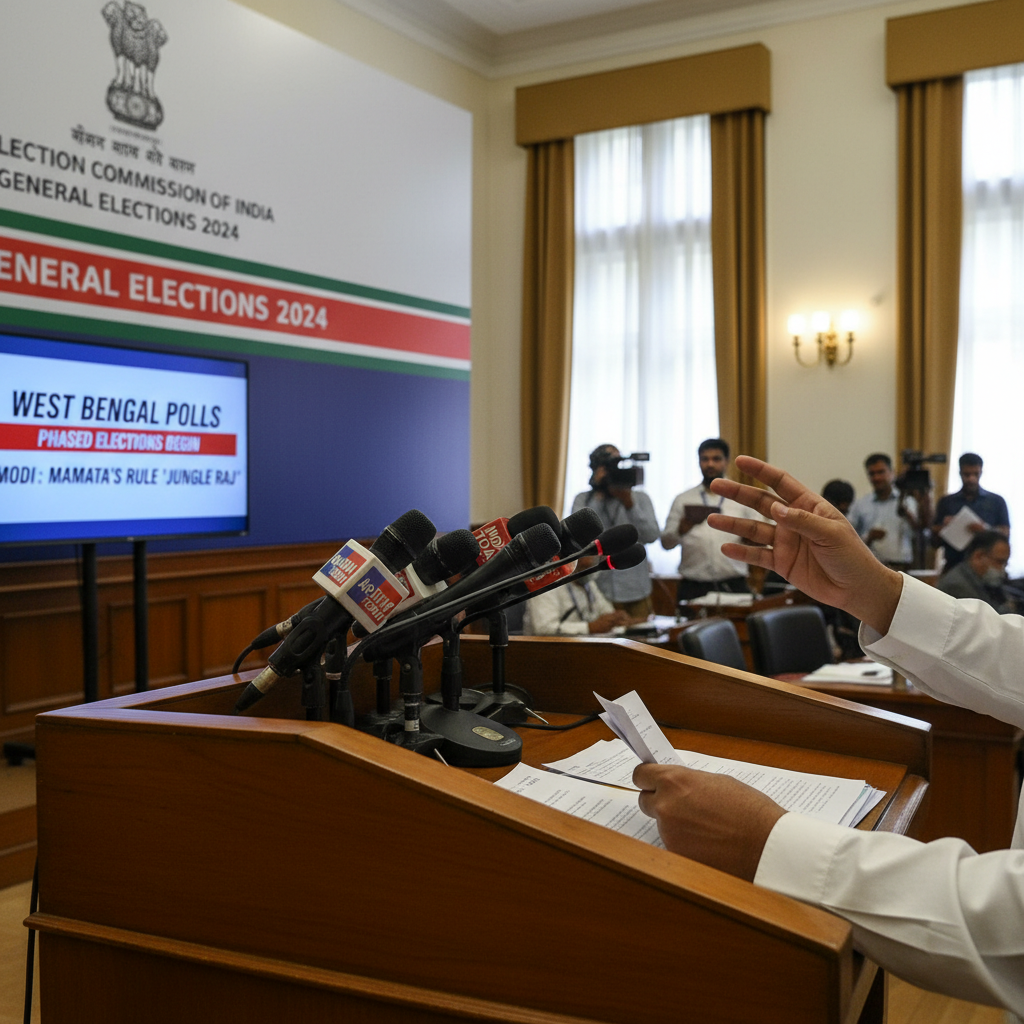
West Bengal Chief Minister Mamata Banerjee faces her toughest electoral test in 15 years as India's most populous eastern state begins voting on 23 April 2026. All 294 seats in the Legislative Assembly are contested across two phases, with results expected on 4 May 2026. Prime Minister Narendra Modi has put himself at the centre of the BJP's campaign, calling Banerjee's Trinamool Congress rule "Maha Jungle Raj" and accusing the party of playing "a dangerous game of appeasement," according to the Deccan Herald.
The Details
Phase 1 polling covers 152 constituencies on 23 April. The remaining 142 seats go to voters on 29 April, according to Wikipedia's documentation of the election schedule. The Legislative Assembly's current term expires on 7 May 2026, making the timeline tight for whichever party forms government.
Banerjee and her All India Trinamool Congress (AITC) have governed West Bengal without interruption since 2011 — a 15-year hold on power. The 2021 election gave AITC a commanding 215 seats on 48.02% of the vote, according to Wikipedia. The BJP won 77 seats and 38.15% of votes in that contest, positioning Suvendu Adhikari as its state-level standard-bearer. Adhikari is contesting from two constituencies this cycle: Nandigram and Bhabanipur.
The BJP is fielding candidates in all 294 seats. Its central campaign messages focus on border security and migration, particularly around the strategically sensitive Siliguri Corridor, and on the Citizenship Amendment Act (CAA), with a promise to accelerate citizenship processing for eligible applicants if elected, according to Wikipedia.
Women's safety has emerged as a major campaign fault line. The 2024 rape and murder of a trainee doctor at R.G. Kar Medical College and Hospital in Kolkata drew sustained national attention and remains a live grievance against the state government, according to Wikipedia. The opposition has used the case as a primary line of attack on Banerjee's administration.
The 2022 School Service Commission recruitment scam has also become a focal point of opposition attacks on the AITC. The scam, which involved alleged irregularities in government teaching appointments, has handed BJP and other opposition parties a concrete accountability argument against the ruling party, according to Wikipedia.
Electoral administration has become a contested issue in its own right. A Special Intensive Revision (SIR) of the electoral roll removed approximately 9 million voters — roughly 12% of the total electorate. Around 2.7 million cases remain pending as of the election period, according to Wikipedia. Opposition parties and civil society groups have raised concerns about the scope of removals.
Context
The 2026 contest takes place against a backdrop of converging religious and political symbolism that has reshaped the campaign's visual language. NDTV reported that TMC adopted "Jai Shree Ram" — a slogan long associated with the BJP and the broader Hindu nationalist movement — as part of its own campaign messaging. Both parties are now openly competing for Hindu religious symbolism in a state where that terrain was previously considered BJP-exclusive territory.
The Matua community — a Hindu refugee group with deep ties to the CAA debate — constitutes a significant vote bank in West Bengal, according to Wikipedia. Their position on CAA and the SIR removals makes them a contested constituency, with both TMC and BJP aware of the group's potential to shift seat outcomes in border-adjacent districts.
The 2021 result set the baseline: BJP made major gains from its 2016 showing but fell well short of dislodging AITC. The party has since attempted to nationalise the Bengal contest — putting Modi, not Adhikari, at the face of the campaign — while TMC is running on incumbency and local development messaging, according to NDTV.
What's Next
Phase 1 polling proceeds on 23 April across 152 constituencies. Phase 2 covers the remaining 142 seats on 29 April. Counting is scheduled for 4 May 2026, according to Wikipedia. The results will determine whether AITC secures a fourth consecutive term or the BJP achieves what would be its first state government win in West Bengal.
The 2.7 million pending SIR cases remain unresolved through the polling period, according to Wikipedia. Any significant dispute over voter rolls could affect post-election legal proceedings or result challenges, depending on margin outcomes in affected constituencies.
Never Miss a Signal
Get the latest breaking news and daily briefings from Zero Signal News directly to your inbox.