
More Than 75,000 Tariff Refund Requests Filed Through CBP's New CAPE Portal, With Roughly 15% Reportedly Rejected
Zero Signal Staff
Published April 28, 2026 at 7:13 PM ET · 151 days ago
CBS News; U.S. Customs and Border Protection; Reuters Westlaw Today; Troutman Pepper Locke
U.S.
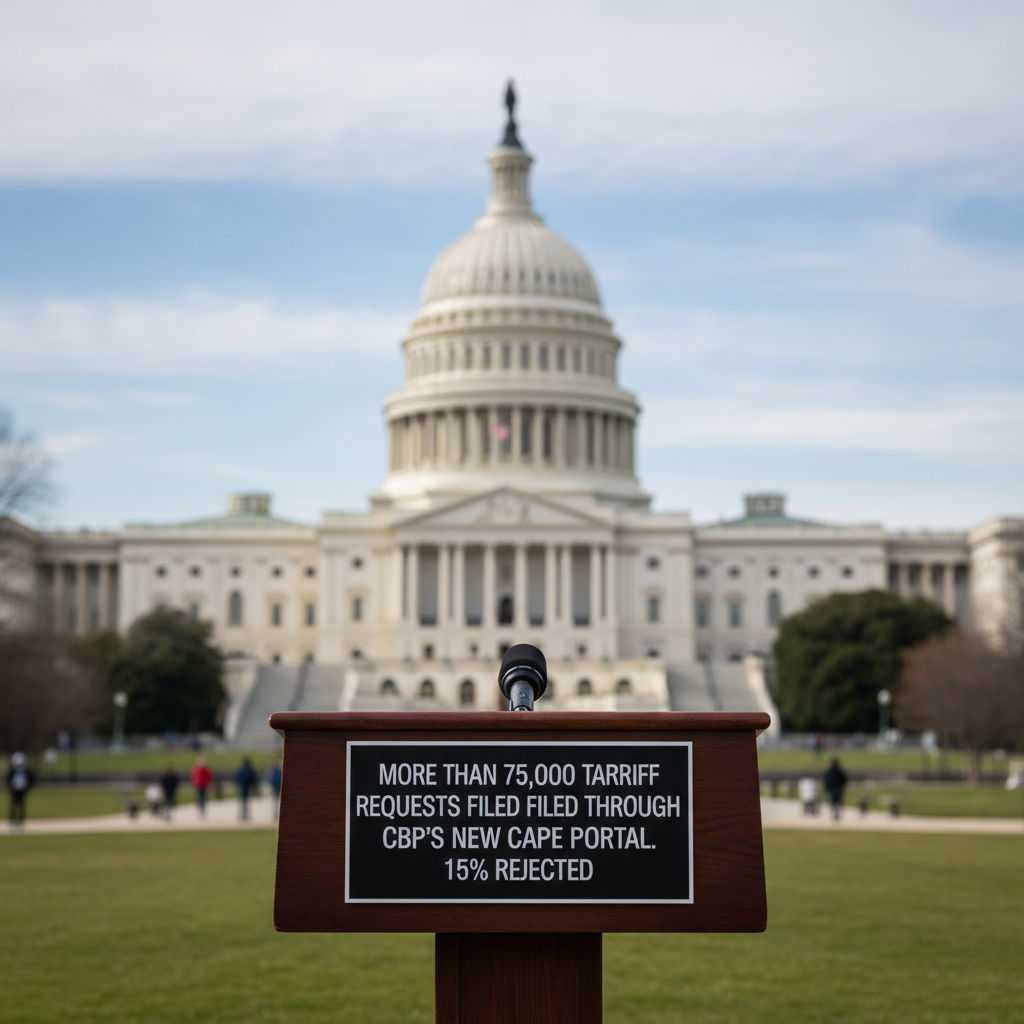
U.S. Customs and Border Protection had received more than 75,000 refund requests through its new CAPE portal as of April 26, 2026, less than a week after the system launched to process repayments for tariffs that the Supreme Court struck down in February. According to CBS News, a court filing by CBP official Brandon Lord indicated that roughly 15% of those submissions had been rejected, though the exact scope of that figure is unclear because public data mix requests, claims, and individual tariff payments without a consistent denominator.
The Details
CBP launched Phase 1 of the CAPE refund process on April 20, 2026, to handle repayment claims for duties collected under the International Emergency Economic Powers Act, according to CBP. The portal operates through the agency's existing ACE trade platform and serves as the exclusive administrative path for importers seeking IEEPA refunds covered by Phase 1.
As of April 26, CBP had received more than 75,000 refund requests, according to CBS News, which cited the Brandon Lord court filing. Of those, more than 47,000 claims covering roughly 11 million individual tariff payments had been properly filed, the same filing indicated.
CBS News reported that roughly 15% of submissions had been rejected since launch. The outlet attributed the figure to the Lord filing, but the brief's research notes that public summaries of that data use the terms 'refund requests,' 'claims,' and 'tariff payments' inconsistently, making the precise numerator and denominator behind the 15% figure difficult to reconstruct from public sources alone.
Nick Richards, a partner at Greenspoon Marder, told CBS News that the rejections were not necessarily surprising. 'There are parameters, and I would imagine some of the submissions are outside of that scope,' Richards said, explaining why some CAPE claims may be deemed ineligible rather than deficient.
Trade lawyers and independent legal guidance from Troutman Pepper Locke describe CAPE as the sole filing path for covered IEEPA refund claims. Those writeups caution that file-level formatting errors or missing required fields can cause an entire declaration to be rejected and require resubmission — a filing-mechanics issue rather than a substantive determination on the underlying claim.
Context
The refund program exists because the Supreme Court invalidated Trump-era tariffs imposed under the International Emergency Economic Powers Act in February 2026, according to Reuters Westlaw Today. That ruling prompted follow-on orders from the Court of International Trade directing CBP to refund those duties through an administrative process. The CAPE portal went live on April 20 as the vehicle for that process, Reuters reported.
CBP says Phase 1 is limited to certain unliquidated entries and certain entries within 80 days of liquidation, according to the agency. More complex scenarios — including older or more complicated entries — are expected to be addressed in later phases or through separate protest procedures, CBP and trade lawyers say.
For claims that are accepted, CBP guidance says refunds are typically issued via ACH within 60 to 90 days, unless extra review is required. That timeline means importers who file successfully in late April could see repayments by summer, though no guaranteed disbursement date has been announced.
What's Next
Trade lawyers at Reuters Westlaw Today have urged importers to file quickly, warning that the Phase 1 window is shrinking. 'Given CBP did not exercise its authority under 19 C.F.R. § 159.12(a)(1) to grant importers' requests to extend liquidation of unliquidated entries with IEEPA tariffs, entries will continue to liquidate as time passes,' wrote Chris Duncan and Anya Bharat Ram in Reuters Westlaw Today, noting that entries aging past the Phase 1 eligibility thresholds may fall out of coverage entirely.
CBP has indicated that later phases of the CAPE process will address more complicated entry categories, though the agency has not announced a timeline for those releases. Importers whose claims fall outside Phase 1's current scope are advised to consult trade counsel about protest procedures or wait for subsequent phases.
Never Miss a Signal
Get the latest breaking news and daily briefings from Zero Signal News directly to your inbox.