
North Carolina Lifts Burn Ban In 81 Counties As Drought And Fire Risk Persist
Zero Signal Staff
Published May 4, 2026 at 8:41 PM ET · 161 days ago
NC Agriculture
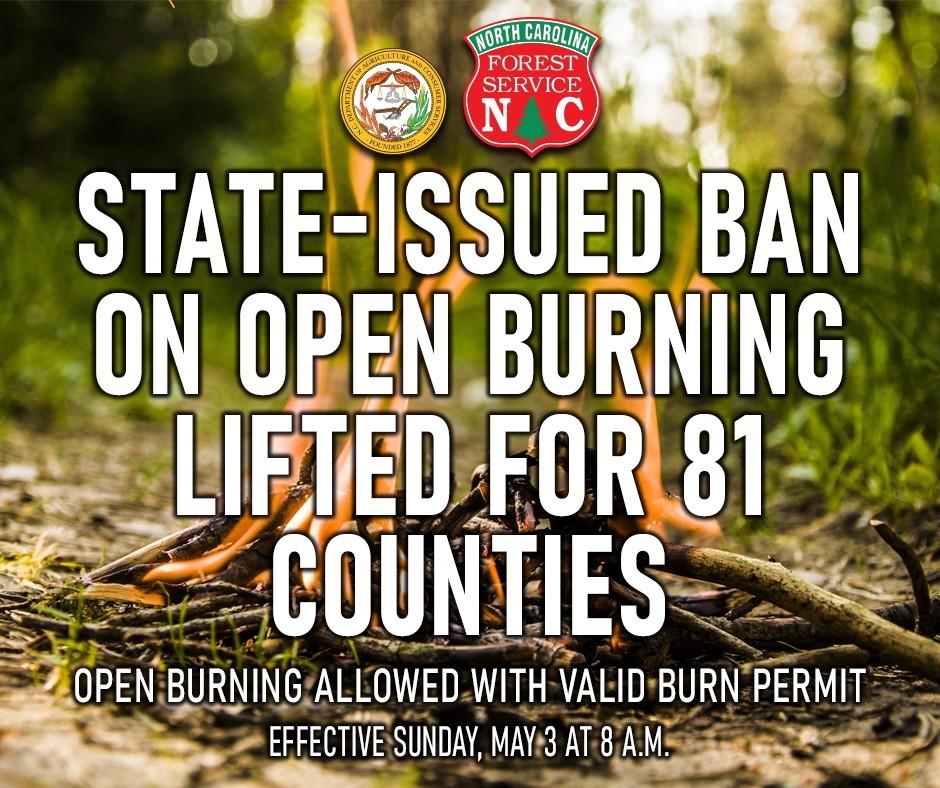
North Carolina lifted its state ban on open burning in 81 counties on Sunday morning after recent rainfall moderated fire danger, according to the N.C. Forest Service.
North Carolina lifted its state ban on open burning in 81 counties on Sunday morning after recent rainfall moderated fire danger, according to the N.C. Forest Service. Nineteen counties remained under the restriction, and state drought officials continued to warn that drought and wildfire danger had not ended.
The Details
The N.C. Forest Service said the state ban on open burning was lifted for 81 counties effective 8 a.m. Sunday, May 3. North Carolina agriculture commissioner Steve Troxler said in the agency announcement that recent rainfall had provided some relief and had moderated fire danger enough for the state to remove the restriction in those counties.
The change was partial, not statewide. WRAL reported that Alamance, Anson, Cabarrus, Chatham, Davidson, Davie, Forsyth, Gaston, Guilford, Iredell, Mecklenburg, Montgomery, Moore, Randolph, Rockingham, Rowan, Stanly, Stokes and Union counties remained under the burn ban after the Sunday change.
The statewide ban had been in place since March 28 because of hazardous fire conditions tied to intense drought across North Carolina, according to WRAL. The N.C. Forest Service said burn permits became available again at 8 a.m. Sunday in the 81 counties no longer covered by the state ban. Permits that had been issued before the statewide ban were canceled, according to the agency.
The N.C. Forest Service said the lift does not apply to fires started within 100 feet of an occupied dwelling. In those cases, local fire marshals retain authority, according to the agency. That limit means residents in counties removed from the state ban still must account for local rules before burning.
Troxler's announcement paired the partial reopening with a caution about conditions that can shift quickly. "The recent rainfall has provided some relief and has moderated fire danger enough for us to lift the ban on open burning in 81 counties," Troxler said, according to NC Agriculture. "However, we're still in the thick of spring wildfire season when conditions can change quickly and frequently. We still need rain to move us forward with drought recovery, improving soil moisture and water levels."
The timeline shows how quickly the state's posture changed while the underlying drought remained. North Carolina imposed the statewide burn ban on March 28, WRAL reported. On April 27, state officials said weekend rain was not enough to ease drought and wildfire conditions and kept the statewide ban in place, according to NC Agriculture. By May 3, the N.C. Forest Service said conditions had improved enough to lift the restriction in most counties while keeping 19 counties under the ban.
Context
The drought picture remained severe even after the rainfall that allowed the state to loosen restrictions in most counties. The Center Square reported that updated U.S. Drought Monitor metrics still showed 100% of North Carolina in at least moderate drought, with 95.5% in severe to exceptional drought and 54.9% in extreme to exceptional drought.
The North Carolina Drought Management Advisory Council's April 28 advisory continued urging drought response actions statewide. The council said wildfire danger is higher than normal in the drought categories affecting the state.
The dry conditions had already produced a large fire response before the partial lift. NC Agriculture said on April 27 that most of North Carolina still needed 10 inches of rain or more and that more than 1,200 wildfires had burned nearly 3,500 acres since the March 28 burn ban began.
Other drought indicators pointed in the same direction. Drought.gov said 9.5 million North Carolina residents were in drought-affected areas and that March 2026 was the state's fifth-driest March on record. WBTV reported that exceptional drought had spread into Mecklenburg, Cabarrus, Stanly and Union counties, helping explain why Charlotte-area restrictions remained in place.
What's Next
The immediate next step is split by county. In the 81 counties removed from the state ban, NC Agriculture said burn permits became available again Sunday morning, while fires within 100 feet of occupied dwellings remained subject to local fire marshal authority.
In the 19 counties still covered by the state restriction, the burn ban continued after the May 3 change, according to WRAL. The North Carolina Drought Management Advisory Council's April 28 advisory continued to call for drought response actions statewide, and Troxler said North Carolina still needed rain to improve soil moisture and water levels.
Never Miss a Signal
Get the latest breaking news and daily briefings from Zero Signal News directly to your inbox.