
NTSB: Overlapping Failures in Communication and Tracking Caused Deadly LaGuardia Runway Crash
Zero Signal Staff
Published April 23, 2026 at 5:31 PM ET · 156 days ago
NTSB
Federal investigators said a cascade of overlapping failures — including a missing vehicle transponder, a surveillance system that generated no runway-incursion alert, and conflicting information about air traffic control duties — contributed to the
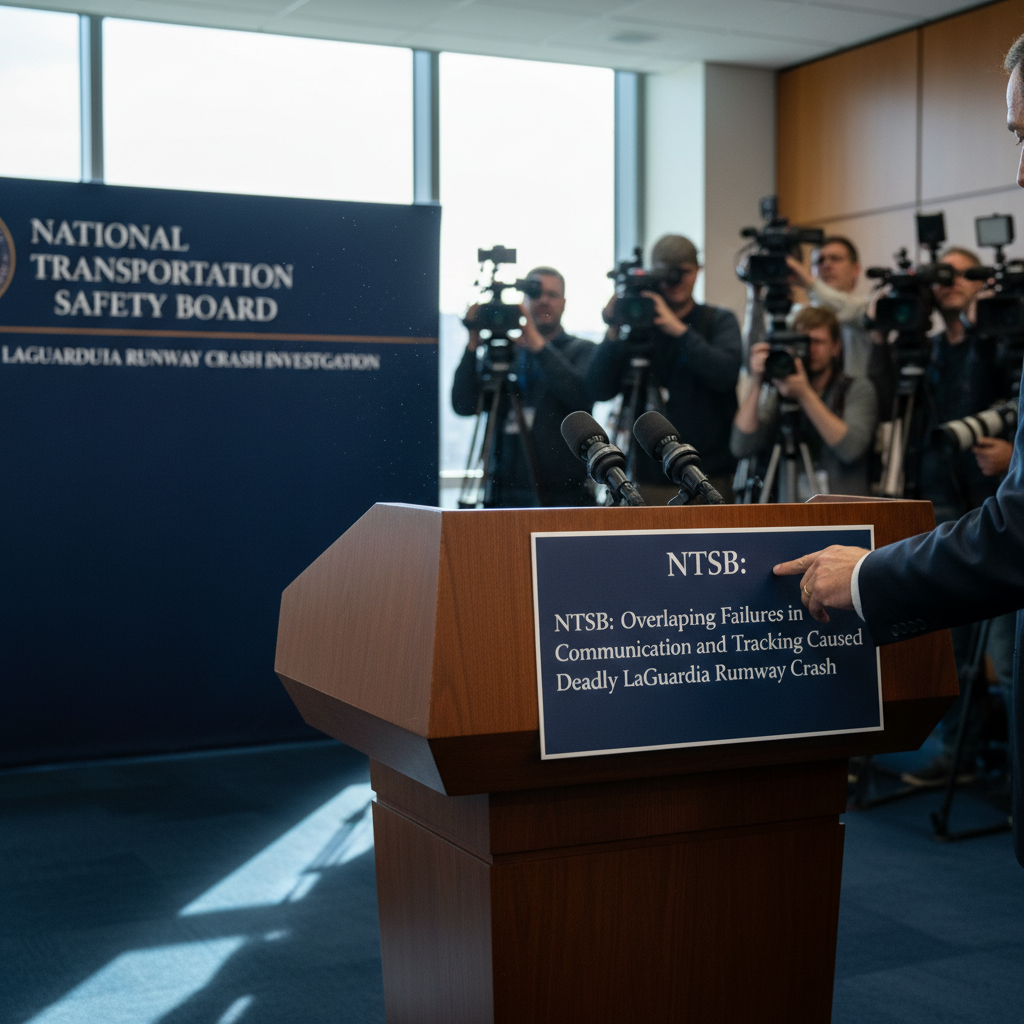
Federal investigators said a cascade of overlapping failures — including a missing vehicle transponder, a surveillance system that generated no runway-incursion alert, and conflicting information about air traffic control duties — contributed to the March 22 runway collision at LaGuardia Airport that killed two pilots. The National Transportation Safety Board's preliminary findings trace the fatal crash to systemic gaps rather than a single mistake, according to NTSB Chair Jennifer Homendy.
The Details
The collision occurred at 11:37 p.m. EDT on March 22, 2026, when Jazz Aviation Flight 646, operating as Air Canada Flight 8646 from Montreal to New York, struck Rescue 35 — an airport fire truck — while landing on Runway 4, according to the NTSB. The aircraft's captain, Antoine Forest, 30, and first officer Mackenzie Gunther were killed. The NTSB reported that 39 other people were transported to hospitals, with six serious injuries initially recorded.
One of the central findings involves the fire truck itself: Rescue 35 did not carry a transponder that would have transmitted its precise location to air traffic control, Reuters reported. That gap limited controllers' real-time awareness of the truck's position on the airfield. Homendy, speaking at a public briefing, said, "Controllers should have all the information, the tools to do their job. You have to have information on ground movements, whether that's aircraft or vehicles moving."
The airport's ASDE-X surface surveillance system, designed to detect and alert controllers to potential runway incursions, did not generate an alert before the collision, according to Reuters. Runway status lights — which indicate when it is unsafe to cross — were operating at the time, Homendy confirmed. According to CBS News New York, cockpit voice recorder data showed only about 20 seconds elapsed between the fire truck receiving clearance to cross Runway 4 and the end of the recording, with the aircraft approximately 100 feet above ground 19 seconds before impact.
Investigators also found unclear lines of responsibility in the LaGuardia tower. Two controllers were working in the cab at the time, but the NTSB said there was conflicting information about which controller was performing ground-control duties, according to NPR. Federal investigators are examining controller staffing procedures and whether radio communications with the truck were clear and acknowledged, NPR reported.
Homendy cautioned against narrowing the cause to any single point of failure. "This is a heavy workload environment," she said at the briefing, as reported by CBS News New York. "We rarely, if ever, investigate a major accident where it was one failure." The NTSB posted an updated preliminary investigation summary on April 23, 2026.
Context
Flight 8646 was a scheduled regional service operated by Jazz Aviation as Air Canada Express, running from Montreal to New York under Part 129 of federal aviation regulations, according to NTSB documents. The flight was on final approach to LaGuardia when the collision occurred late at night.
The ASDE-X system is a surface surveillance technology that tracks aircraft and vehicles on airport grounds and is intended to alert controllers to potential runway conflicts. Investigators said the system did not generate a runway-incursion alert before Rescue 35 entered the runway, according to Reuters. Separately, the fire truck did not carry a transponder that would have broadcast its position to air traffic control, Reuters reported, which meant controllers lacked automated real-time data on the vehicle's precise location.
The question of who held responsibility for ground control in the tower that night remained unresolved in the preliminary investigation. Investigators found conflicting information about which of the two on-duty controllers was performing ground-control duties at the time of impact, according to NPR. NPR reported that federal investigators were also examining controller staffing procedures as part of the inquiry.
What's Next
The NTSB posted an updated preliminary investigation summary on April 23, 2026, according to the agency. Preliminary reports are early-stage findings and do not include probable cause determinations.
NPR reported that investigators are examining whether radio communications between the tower and the fire truck were clearly transmitted and acknowledged before the truck entered Runway 4. The review of controller staffing procedures, vehicle-tracking gaps, and the ASDE-X system's performance all remain open lines of inquiry, according to NPR and the NTSB.
Never Miss a Signal
Get the latest breaking news and daily briefings from Zero Signal News directly to your inbox.