
Pedestrians Help Delivery Robots Over Curb in Finland
Zero Signal Staff
Published April 15, 2026 at 9:21 PM ET · 184 days ago
ABC News
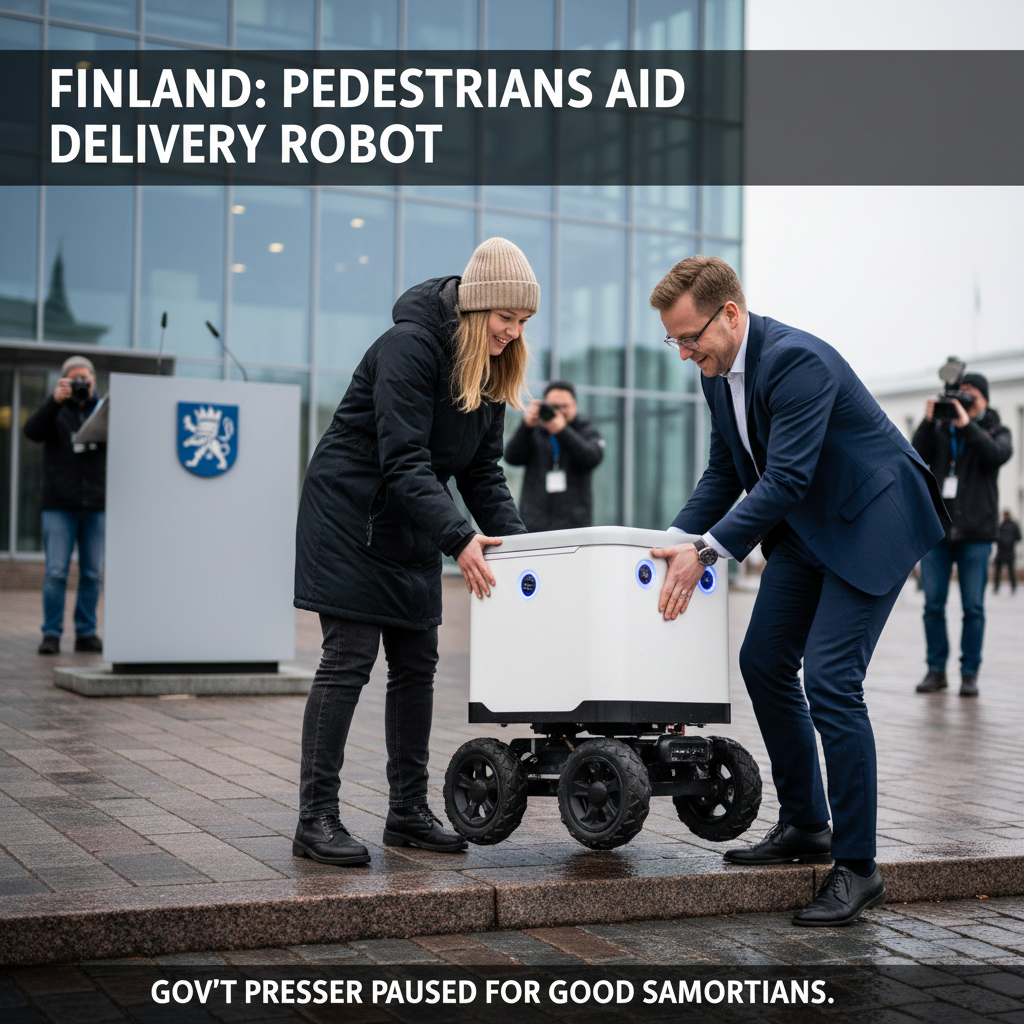
Two food delivery robots received assistance from bystanders after becoming stuck on a curb in Turku, Finland on April 15, 2026.
Two food delivery robots received assistance from bystanders after becoming stuck on a curb in Turku, Finland on April 15, 2026. Video of the incident captured the moment helpful pedestrians intervened to help the autonomous machines complete their route.
The delivery robots, which operate as part of a food delivery service in the Finnish city, encountered an obstacle they could not navigate independently. The curb presented a physical barrier that exceeded the robots' climbing capability, leaving them immobilized on the street. Pedestrians who witnessed the struggle stepped in to manually lift the robots over the curb, allowing them to continue their deliveries.
The incident highlights a practical limitation of current autonomous delivery technology. While these robots can navigate flat surfaces and follow programmed routes, they lack the mechanical capability or artificial intelligence to overcome common urban obstacles like curbs and steps. The reliance on human intervention in such situations underscores the gap between autonomous systems and fully independent operation.
The video of the incident circulated on social media, with viewers expressing amusement at the robots' predicament and appreciation for the pedestrians' willingness to help. The moment reflects broader questions about how autonomous delivery systems will function in real-world urban environments where infrastructure is not uniformly designed for small robotic devices.
Context
Autonomous delivery robots have expanded across European cities over the past three years, with Finland emerging as a testing ground for the technology. Similar robots operate in cities including Helsinki, where they have faced comparable challenges with infrastructure designed for human pedestrians and vehicles rather than small autonomous units. Previous incidents involving delivery robots have included navigation failures on slopes, difficulties with uneven surfaces, and challenges crossing streets safely.
The robots typically weigh between 10 and 20 kilograms and operate on flat terrain with minimal obstacles. Their design reflects current technological constraints in battery life, sensor accuracy, and mechanical durability. Cities implementing these services have had to assess whether existing sidewalks and curbs require modification to accommodate autonomous delivery.
What's Next
As delivery robot services expand across urban areas, cities will face decisions about infrastructure modifications to support autonomous vehicles. Some municipalities are beginning to evaluate curb design standards and sidewalk specifications that could accommodate smaller robotic devices without requiring human assistance. The incident in Turku may prompt service operators to map problematic areas and either reprogram routes to avoid obstacles or advocate for localized infrastructure changes.
The broader question remains whether autonomous delivery will require cities to redesign public spaces or whether the technology will need to advance to handle existing urban environments independently. Current trajectory suggests a combination of both approaches will likely occur over the next 2-3 years.
Never Miss a Signal
Get the latest breaking news and daily briefings from Zero Signal News directly to your inbox.