
Port Authority to Install Rescue-Vehicle Transponders After LaGuardia Crash Exposed Tracking Gap
Zero Signal Staff
Published April 28, 2026 at 7:14 PM ET · 151 days ago
New York Times
The Port Authority of New York and New Jersey said Tuesday it will install transponders on rescue vehicles at LaGuardia, JFK, and Newark airports — a direct response to the March 22 fatal runway collision at LaGuardia, where federal investigators fou
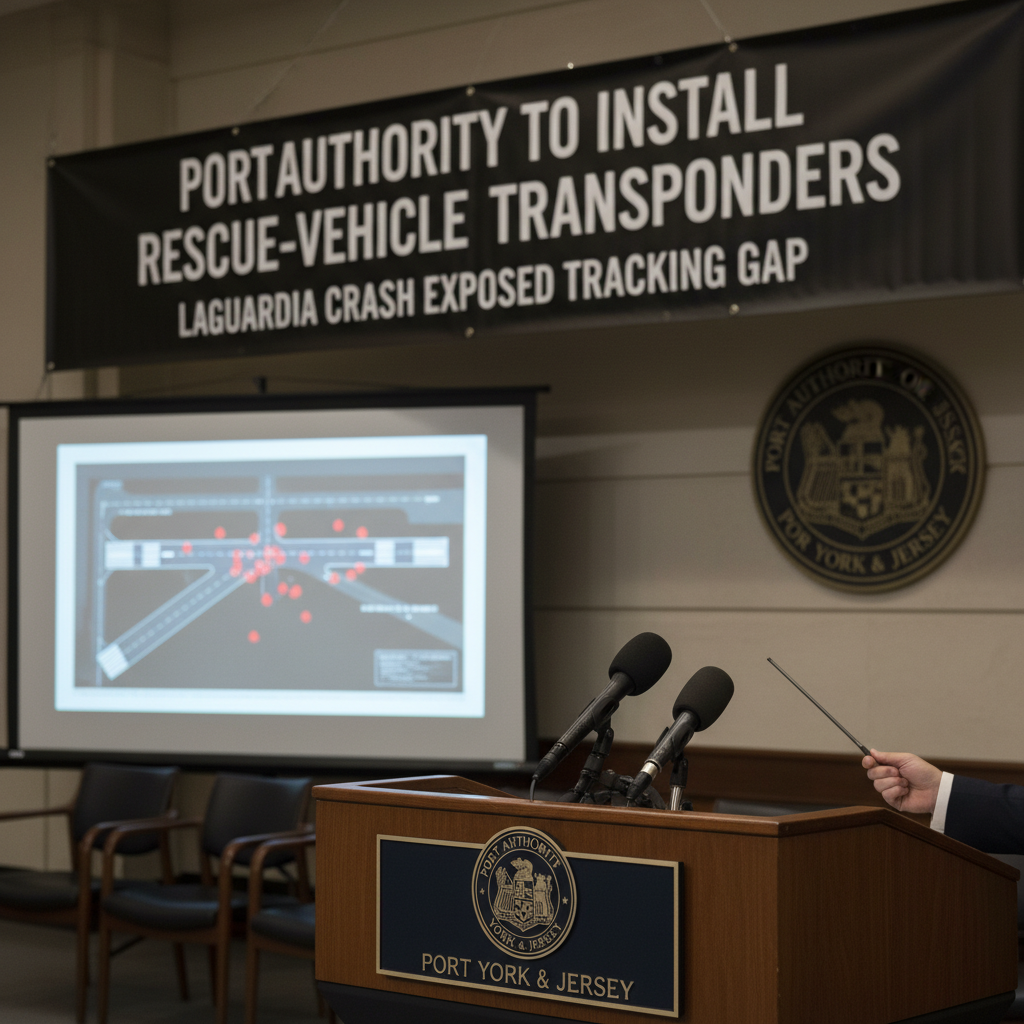
The Port Authority of New York and New Jersey said Tuesday it will install transponders on rescue vehicles at LaGuardia, JFK, and Newark airports — a direct response to the March 22 fatal runway collision at LaGuardia, where federal investigators found the fire truck involved in the crash lacked the device that would have broadcast its location to air traffic control.
The Details
The announcement, attributed to Port Authority spokesman James Allen by the New York Times, marks a reversal for the agency. Port Authority officials had previously chosen a different vehicle-tracking approach they viewed as better suited to monitoring ground movements across the whole airfield rather than just runways and taxiways, according to the New York Times.
The March 22 collision at LaGuardia killed the two pilots aboard an Air Canada Express jet after a Port Authority fire truck entered the runway while responding to a separate emergency, according to Reuters and the Associated Press. The crash set off a federal safety investigation that quickly turned to questions about why the truck's movements were not flagged before the collision.
National Transportation Safety Board investigators found that the fire truck was not equipped with a transponder that would have transmitted its precise location to air traffic controllers, according to Reuters. Without that signal, LaGuardia's ASDE-X surface surveillance system — which is designed to track aircraft and vehicles on the airfield — did not reliably track the truck and did not generate an audio or visual conflict alert before the crash, the NTSB said in preliminary findings reported by the Associated Press, CNN, and Reuters.
NTSB Chair Jennifer Homendy said of the gap in controller awareness: "Controllers should have all the information, the tools to do their job," according to Reuters. The NTSB has not issued a final determination on the crash, and the agency has not concluded that a transponder would definitively have prevented the collision.
James Allen, the Port Authority spokesman, said the agency's decision to expand transponder use across its airports reflects the technology's value as a supplement, not a replacement, for existing systems. "Transponder technology can provide an additional layer of visibility on top of existing surface-surveillance systems that already track ground movements," Allen said, according to the New York Times.
Context
The Federal Aviation Administration has encouraged airports for years to equip airfield vehicles with transponders — sometimes referred to as VMATS, for Vehicle and Equipment Monitoring and Alerting Technology — so controllers can better track movements and identify potential runway conflicts, according to Reuters and WPLG Local 10. That guidance has remained voluntary; the FAA has not required airports to install the devices.
Several major airports have already adopted the transponder approach on their vehicles. The New York Times reported that Boston, Chicago, Denver, Los Angeles, Minneapolis, St. Louis, and San Francisco are among those using transponders on airfield vehicles.
The LaGuardia crash renewed scrutiny of the FAA's voluntary guidance beyond the New York metro area. WPLG Local 10 reported that Miami International Airport recently ordered transponders for nine emergency response vehicles in the wake of the crash.
What's Next
The Port Authority has not announced a specific timeline for completing the transponder installations at LaGuardia, JFK, and Newark, as of Tuesday. The planned rollout is attributed to spokesman James Allen in the New York Times report; no standalone Port Authority press release confirming the program was located independently.
The NTSB investigation into the March 22 collision remains open. The agency's preliminary findings have identified the missing transponder as a factor in the surveillance gap; a final report with formal safety recommendations has not yet been issued.
Never Miss a Signal
Get the latest breaking news and daily briefings from Zero Signal News directly to your inbox.