
Private Credit, AI, and Geopolitics Dominate Final Day of Milken Global Conference
Zero Signal Staff
Published May 6, 2026 at 9:15 PM ET · 158 days ago
Bloomberg Businessweek Daily
The 29th annual Milken Institute Global Conference concluded in Beverly Hills on May 6 with senior executives from Wall Street's largest firms grappling with a central tension: an artificial intelligence investment boom colliding with geopolitical di
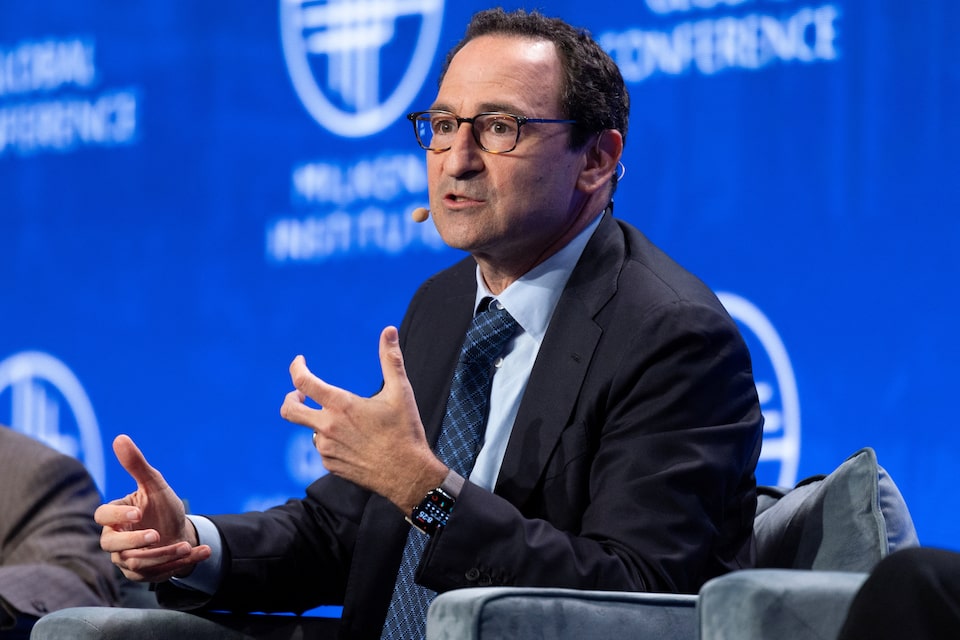
The 29th annual Milken Institute Global Conference concluded in Beverly Hills on May 6 with senior executives from Wall Street's largest firms grappling with a central tension: an artificial intelligence investment boom colliding with geopolitical disruption and growing unease over how private credit is sold to everyday investors.
The Details
The four-day conference, themed 'Leading in a New Era,' drew more than 1,000 speakers and 4,000 participants from nearly 80 countries across sectors including finance, technology, government, and health.
Private credit emerged as the most scrutinized topic on the final day. The $1.8 trillion asset class has faced a retail investor exodus in recent months, and speakers did not shy away from acknowledging the sector's credibility problem.
PJT Partners CEO Paul Taubman delivered a pointed warning onstage, stating that private credit 'is for institutional investors, not retail investors.' He added: 'Retail is a wonderful channel, but you really need to treat it with kid gloves.'
Franklin Resources CEO Jenny Johnson was equally direct: 'We need to make sure the story is clear: Private markets are illiquid.' Per Franzen, CEO of Stockholm-based investment firm EQT AB, went further, predicting that the term 'semi-liquid' will disappear from industry vocabulary altogether, noting that private-credit products are 'not liquid.'
The candor marked a notable shift in tone for an asset class that Michael Milken, the conference's founder and the figure who popularized junk bonds at Drexel Burnham Lambert in the 1980s, helped pioneer.
On artificial intelligence, Blackstone President Jon Gray predicted that the infrastructure buildout required to support AI will create 'a huge boom in blue-collar employment' over the next five years. The remark framed AI investment not only as a bet on semiconductor and data center growth, but as a driver of broader labor demand.
The conference's closing sessions also unfolded against a volatile geopolitical backdrop. Chevron CEO Mike Wirth warned that global oil supplies are 'tightening' due to the closure of the Strait of Hormuz amid the ongoing Iran-US war. US gasoline prices have topped $4.50 a gallon for the first time since July 2022.
The Iran conflict has already rippled into capital markets. JPMorgan's Anu Aiyengar, global head of advisory and M&A, said April was 'challenging' for dealmaking due to 'a bit of stop and start' tied to geopolitical uncertainty. Morgan Stanley Co-President Dan Simkowitz, however, struck a more optimistic note, saying deal pipelines remain 'very strong' despite the headwinds.
On the political front, Citadel CEO Ken Griffin detailed plans to expand Citadel's Miami building, a response that followed New York City Mayor Zohran Mamdani's criticism of Griffin's $238 million Central Park South penthouse in a video advocating taxes on pieds-à-terre. Pershing Square CEO Bill Ackman offered a blunt assessment of Mamdani's proposals, saying he feels 'not great' about the mayor and his ideas for taxing the ultrarich on second homes.
Away from the main stage, Mubadala Investment Co. deputy group CEO Waleed Al Mokarrab Al Muhairi offered reassurance that the Abu Dhabi sovereign wealth fund remains committed to investing in the United States despite regional conflict, helping to placate fears that Middle Eastern capital might pull back.
The conference also featured panels outside the finance mainstream. A session titled 'The Digital Disconnect: Navigating Modern Relationships in a Hyperconnected World' included Match Group CEO Spencer Rascoff, Pew Research Center President Michael Dimock, relationship therapist Laura Berman, and author Matthew Hussey. Separately, a morning panel on veteran entrepreneurship noted that 37% of veteran entrepreneurs reported difficulty accessing capital in a recent national survey.
In a quieter milestone, Apollo Global Management disclosed that it had reached $1 trillion in assets under management for the first time, with $115 billion in quarterly inflows and $300 billion over the past 12 months.
Conference organizers also noted the death of CNN founder Ted Turner at age 87, which was reported during the event.
Context
The Milken Institute Global Conference has long served as a convergence point for capital markets leadership and policy debate, but the 2026 edition arrived at a moment of unusually acute global tension. The Iran-US war has disrupted one of the world's most critical oil transit chokepoints, while the simultaneous AI infrastructure buildout is reshaping investment priorities across sectors.
Richard Ditizio, CEO of the Milken Institute, set the tone in his opening statement: 'We are convening at a moment of profound consequence...When the world feels fractured, this is where the people with the will and the resources to repair it come together—not to talk past each other, but to build real solutions.'
The conference's juxtaposition of private credit's retail trust crisis with trillion-dollar asset growth and AI's promised employment boom underscored the complexity of the current economic landscape. Speakers delivered unusually blunt warnings about product liquidity while celebrating record capital accumulation, reflecting a market in transition between expansion and scrutiny.
What's Next
The private credit industry's handling of retail access will face continued regulatory attention as firms work to rebuild investor trust following recent outflows. Blackstone's projection of a blue-collar employment surge from AI infrastructure suggests labor market impacts from technology investment may materialize faster than in previous cycles, though execution timelines remain unclear.
Geopolitically, dealmakers will watch whether the Strait of Hormuz closure persists and whether Morgan Stanley's characterization of 'very strong' pipelines translates into closed transactions in the coming quarter. The contrast between JPMorgan's caution and Morgan Stanley's optimism on deal flow indicates that banks are assessing the same conflict through different client exposure and sector lenses.
In New York City, the debate over taxing pieds-à-terre and ultrarich second homeowners is likely to intensify, with prominent financiers signaling both personal and operational consequences if the policy advances.
Never Miss a Signal
Get the latest breaking news and daily briefings from Zero Signal News directly to your inbox.