
Self-Rolling Implant Sustains Vagus Nerve Stimulation for 60 Days in Rat Study
Zero Signal Staff
Published April 30, 2026 at 2:00 AM ET · 150 days ago
Advanced Materials
Researchers at the Shenzhen Institutes of Advanced Technology have published preclinical findings on a flexible bioelectronic implant that wraps around the vagus nerve without sutures and maintained anti-inflammatory activity for 60 days in freely mo
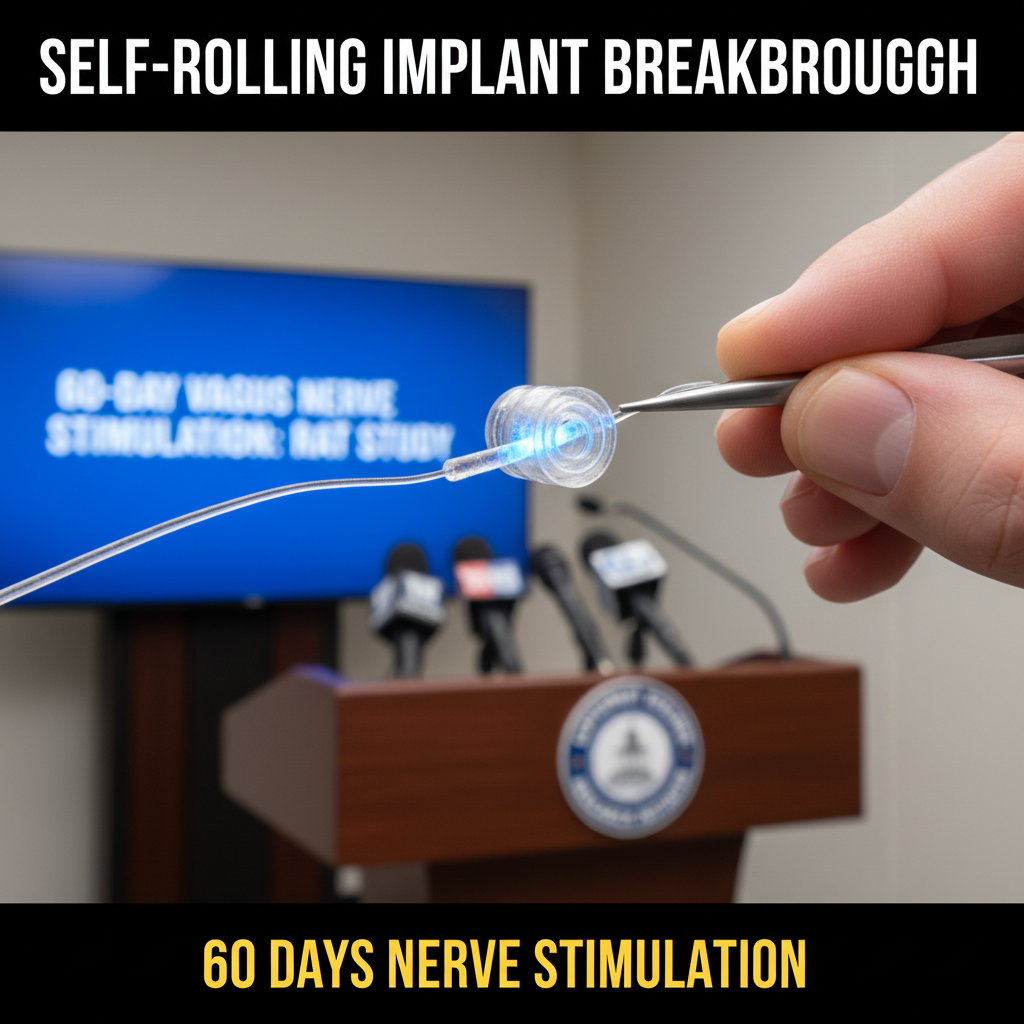
Researchers at the Shenzhen Institutes of Advanced Technology have published preclinical findings on a flexible bioelectronic implant that wraps around the vagus nerve without sutures and maintained anti-inflammatory activity for 60 days in freely moving rats. The device, described in the journal Advanced Materials, uses near-infrared light to trigger neuron-mimetic electrical signals and reduced pro-inflammatory cytokine levels in animal experiments. No human clinical data has been reported.
The Details
The implant, which the research team calls a ferroelectric bioelectronic interface (FBI), combines three materials: a bilayer natural-polymer hydrogel, a ferroelectric layer made from P(VDF-TrFE), and carbon nanotubes. According to the Advanced Materials paper, the combination allows the device to self-roll into a tubular shape that conforms to small nerve structures, gripping them without mechanical fasteners such as sutures.
The suture-free design addresses a known challenge in implantable nerve stimulation hardware. Conventional cuffs that mechanically clamp onto nerves can cause compression or tissue damage over time. The FBI design aims to reduce that risk by using the self-rolling material's geometry to achieve and maintain contact, according to the paper.
When activated using near-infrared light, the interface generates what the researchers describe as neuron-mimetic bioelectrical signaling. The Advanced Materials abstract states that "when applied to the vagus nerves, this adaptive FBI enables near-infrared-mediated neuromodulation that effectively reduces pro-inflammatory cytokine levels." Cytokines are proteins that play a central role in the body's inflammatory response; elevated levels are associated with a range of chronic conditions.
The 60-day animal study tracked implanted devices in freely moving rats. According to the paper and a summary from the Chinese Academy of Sciences, which is affiliated with the Shenzhen Institutes, the devices showed no displacement, nerve compression, or local inflammation at the implantation site over that period. The Chinese Academy of Sciences release noted that "after 60-day implantation in freely moving rats, the FBI showed no signs of displacement." The anti-inflammatory effect was also maintained throughout the observation window, per the same sources.
News-Medical and EurekAlert both covered the study and their reporting matched the core claims from the paper and the Chinese Academy of Sciences release, with no material contradictions identified in the available source material.
Context
Vagus nerve stimulation is already cleared for clinical use in certain applications, including some forms of epilepsy and treatment-resistant depression, according to the Advanced Materials paper. Those approved systems typically use surgically implanted electrodes and pulse generators that deliver continuous or scheduled electrical stimulation. The current study does not describe a replacement for any approved system; instead, it focuses on the interface material itself — specifically on whether a self-rolling, adhesive design can remain stable and biologically safe at the nerve surface over an extended period.
The distinction matters because the long-term biosafety of implantable neural interfaces is an active area of hardware research. A device that shifts position, compresses surrounding tissue, or provokes an immune response at the implant site can lose effectiveness or cause harm. The FBI's 60-day rat-model results are one data point in that line of inquiry, according to the paper and Chinese Academy of Sciences summary.
The source set for this study consists primarily of the peer-reviewed paper itself. Coverage by News-Medical and EurekAlert is largely derivative of the paper and the institutional release from the Chinese Academy of Sciences, and no independent outside-expert commentary was identified in the available reporting.
What's Next
The published findings are preclinical. The paper and related institutional reporting describe only rat-model experiments; no human trials, regulatory submissions, or clinical timelines are mentioned in the available sources. Further research would typically include larger animal models and safety studies before any step toward human testing, though neither the paper nor affiliated summaries specify what the research team's planned next steps are.
The Advanced Materials paper is available at https://doi.org/10.1002/adma.73023 for researchers and clinicians interested in the device's design and methodology.
Never Miss a Signal
Get the latest breaking news and daily briefings from Zero Signal News directly to your inbox.