
Stanford Chip-Scale Optical Amplifier Boosts Light Signals 100-Fold on Under 200 Milliwatts
Zero Signal Staff
Published May 6, 2026 at 6:03 AM ET · 159 days ago
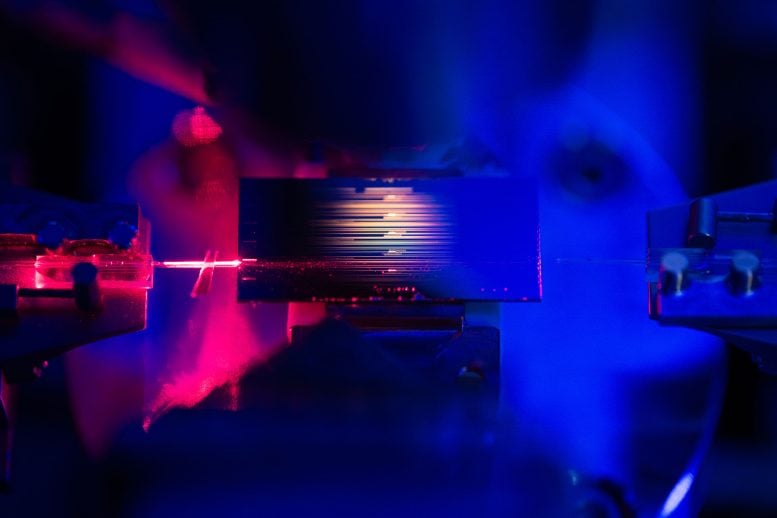
Nature / ScienceDaily
A Stanford research team has demonstrated a chip-scale optical amplifier capable of increasing light-signal intensity by roughly 100 times while drawing less than 200 milliwatts of power, a combination that opens a path toward battery-powered photoni
A Stanford research team has demonstrated a chip-scale optical amplifier capable of increasing light-signal intensity by roughly 100 times while drawing less than 200 milliwatts of power, a combination that opens a path toward battery-powered photonic devices in consumer electronics.
The Details
The device, described in a Nature study published January 28, 2026, achieves more than 17 dB of gain using an integrated optical parametric amplifier architecture built on thin-film lithium niobate. Rather than relying on conventional single-pass operation, the design improves efficiency by using second-harmonic resonance and recirculating pump light inside a resonator. This energy-recycling approach allows the amplifier to reach roughly 100 times amplification while consuming only a couple hundred milliwatts of power, according to the research team.
Context
Optical parametric amplifiers have long promised broadband, quantum-limited amplification across arbitrary wavelengths, but their adoption has been limited by watt-level power requirements. The Stanford architecture addresses that barrier by recycling the energy of the pump that powers the device, preserving performance without sacrificing other properties. The paper reports that noise performance stayed near the quantum limit over 110 nanometers of bandwidth. Senior author Amir H. Safavi-Naeini, an associate professor of physics at Stanford's School of Humanities and Sciences, said in a university summary: 'We've demonstrated, for the first time, a truly versatile, low-power optical amplifier, one that can operate across the optical spectrum and is efficient enough that it can be integrated on a chip.' Co-first author Devin Dean, a doctoral student in Safavi-Naeini's lab, added: 'By recycling the energy of the pump that powers this amplifier, we made it more efficient, and this doesn't come at a cost to its other properties.' Co-first author Taewon Park also contributed to the work.
What's Next
The fingertip-sized device is intended for next-generation quantum and classical photonics applications. Research summaries have suggested the low-power design could eventually be integrated into devices such as laptops or smartphones, though no commercial deployment timeline has been announced. Because the underlying research dates to January 2026 and the most recent public coverage represents a repackaging of those findings rather than a new announcement, the publication cycle has relied primarily on the Nature paper and Stanford-issued summaries for corroboration.
Never Miss a Signal
Get the latest breaking news and daily briefings from Zero Signal News directly to your inbox.