
Supreme Court Voids Louisiana's Second Black-Majority District, Narrowing Voting Rights Act in Midterm Year
Zero Signal Staff
Published April 29, 2026 at 7:01 PM ET · 150 days ago
PBS NewsHour (AP) / Al Jazeera / The New York Times / U.S. Supreme Court
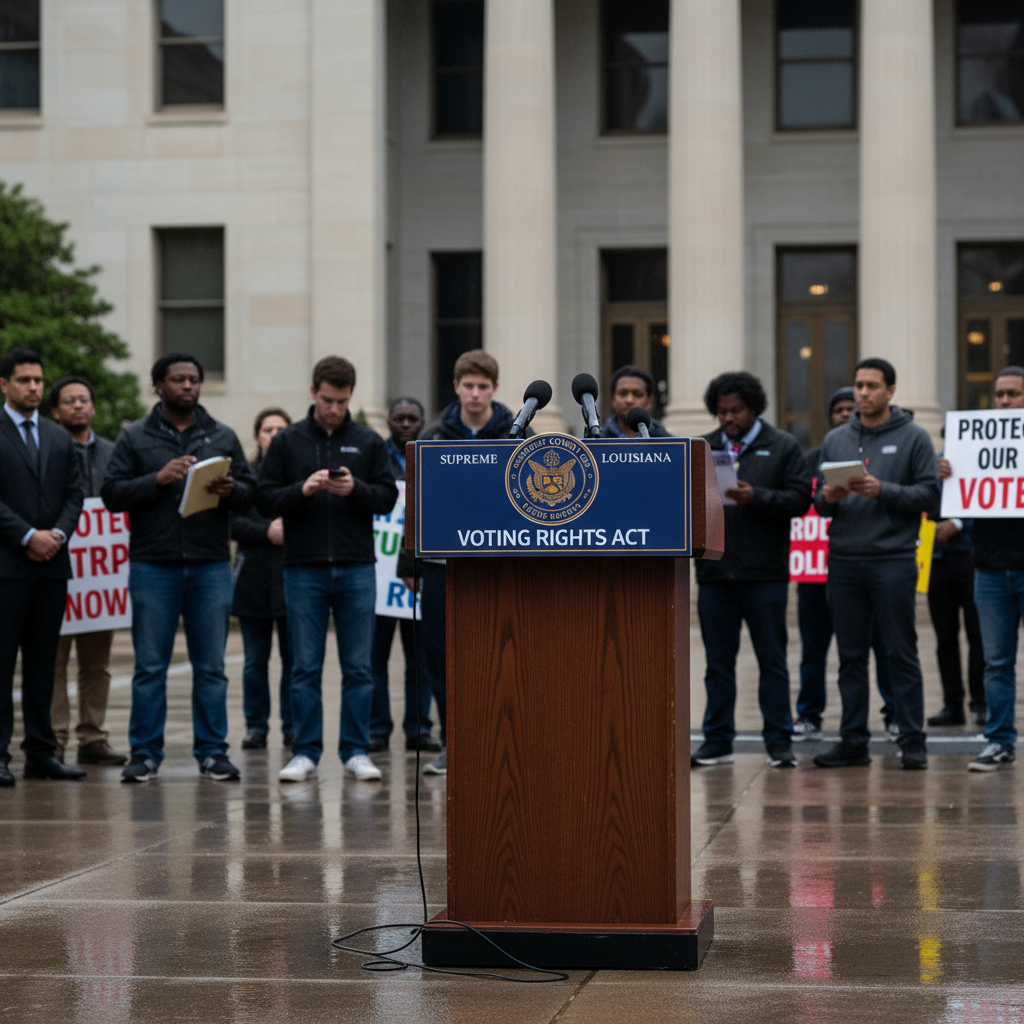
The U.S. Supreme Court ruled 6-3 on Wednesday that Louisiana's second Black-majority congressional district is an unconstitutional racial gerrymander, delivering a major blow to Section 2 of the Voting Rights Act.
The U.S. Supreme Court ruled 6-3 on Wednesday that Louisiana's second Black-majority congressional district is an unconstitutional racial gerrymander, delivering a major blow to Section 2 of the Voting Rights Act. Justice Samuel Alito wrote the majority opinion, which holds that Louisiana lacked a compelling interest to use race in drawing the challenged map because the Voting Rights Act did not require the additional majority-minority district. Justice Elena Kagan dissented on behalf of the Court's three liberal justices, warning that the ruling strips minority voters of key federal protections.
The Details
The case, Louisiana v. Callais, centers on a congressional map Louisiana drew after years of litigation over its post-2020 census plan. According to AP reporting carried by PBS NewsHour, Black residents make up roughly one-third of Louisiana's population, and the state has six U.S. House districts. The challenged map, known as SB8, created two Black-majority districts following earlier court orders. The Supreme Court's majority found that because Section 2 did not compel the second Black-majority seat, the state had no compelling interest to draw the district on racial lines — making SB8 an unconstitutional gerrymander, according to the Court's slip opinion.
Alito wrote in the majority opinion that "that map is an unconstitutional gerrymander," according to AP via PBS. Beyond the Louisiana question, both AP and Al Jazeera reported the ruling effectively narrows how Section 2 can be used nationwide, with the majority requiring proof of intentional racial discrimination rather than discriminatory effect alone. Kagan's dissent put the stakes plainly: "Under the court's new view of Section 2, a state can, without legal consequence, systematically dilute minority citizens' voting power," Al Jazeera reported.
The ideological lineup on the Court was notable. AP via PBS reported that Chief Justice John Roberts and Justice Brett Kavanaugh had joined the liberal bloc in the Alabama Section 2 case less than three years ago, but both joined Alito's majority in this ruling. The Court's decision builds on a longer trajectory of limiting the Voting Rights Act, including the 2013 decision that struck down the law's preclearance formula, according to AP via PBS.
President Donald Trump reacted to the ruling, calling it "the kind of ruling I like," according to AP via PBS and Al Jazeera, as Republicans weighed additional redistricting moves in response.
Context
The political reach of Wednesday's ruling extends well beyond Louisiana's six districts. AP via PBS reported that nearly 70 of the 435 U.S. House seats have been protected at some point by Section 2 of the Voting Rights Act, making the decision's potential ripple effects substantial. The New York Times reported the ruling could trigger a chaotic scramble among states reconsidering their maps ahead of the November midterms.
How quickly that scramble translates into changed seats is uncertain. AP via PBS noted that many 2026 congressional filing deadlines have already passed, which may limit how many states can execute meaningful redraws before November. The broader electoral impact of the ruling, according to AP, may be felt more strongly in 2028 than in this cycle. Louisiana itself may still need to revise its plan, but the timeline for any court-ordered redraw is unresolved.
Florida is the most immediate live test, according to AP via PBS and Al Jazeera. State lawmakers were already debating a new congressional map when the ruling landed, with reports that the proposed plan could add as many as four Republican House seats. Al Jazeera separately reported that Republicans have pushed mid-decade redraws in multiple states, while Democrats remain favored overall to retake the House despite those efforts.
What's Next
Louisiana will likely face additional litigation over how it redraws its congressional map in response to the ruling, though no specific remedial deadline has been publicly set, according to the Court's slip opinion and AP via PBS reporting. The decision is expected to accelerate legal challenges and legislative action in states where majority-minority districts were drawn under Section 2 obligations that the Court has now narrowed.
Florida's ongoing map debate represents the clearest near-term test of the ruling's electoral consequences, according to AP via PBS and Al Jazeera. Whether other states can execute redraws before the 2026 filing deadlines close depends on state-level legislative calendars and court schedules — timelines that remain open, according to AP's reporting.
Never Miss a Signal
Get the latest breaking news and daily briefings from Zero Signal News directly to your inbox.