
Trump Demands NATO Allies Open Military Bases for Iran Operations
Zero Signal Staff
Published April 10, 2026 at 6:15 AM ET · 1 day ago
Politico
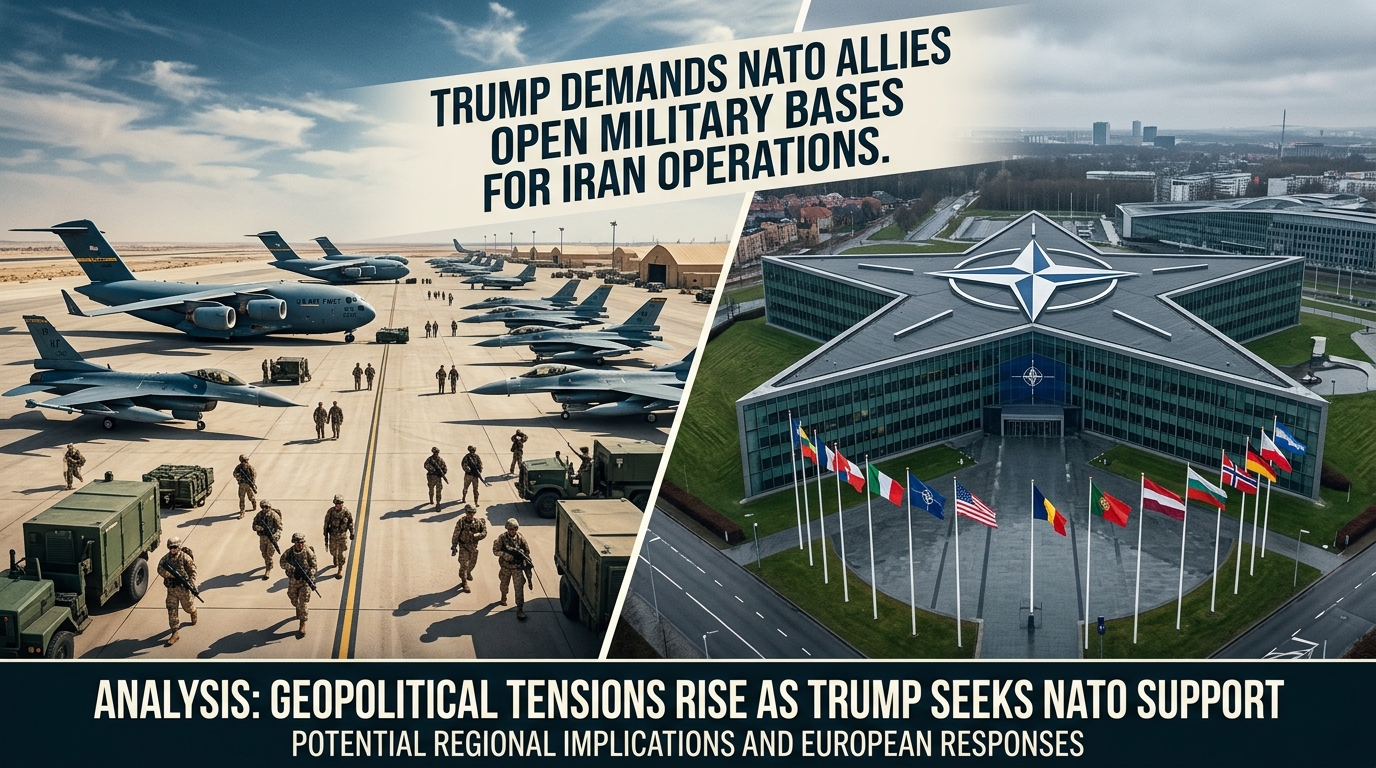
President Donald Trump's heated confrontation with NATO Secretary General Mark Rutte on Wednesday centered on his anger that European allies refused to grant the U.S. access to military bases for operations against Iran.
President Donald Trump's heated confrontation with NATO Secretary General Mark Rutte on Wednesday centered on his anger that European allies refused to grant the U.S. access to military bases for operations against Iran. The closed-door meeting lasted hours, with Trump fixating almost exclusively on what he viewed as allied betrayal, according to three people familiar with the discussion.
Trump made no formal ultimatums or threats to withdraw from NATO during the meeting, but he repeatedly expressed frustration that countries including Spain and France denied U.S. warplanes use of their airspace and bases for the five-week conflict with Iran. Secretary of State Marco Rubio articulated the administration's position publicly last week, asking on Fox News: "When we need them to allow us to use their military bases, their answer is no? Then why are we in NATO?"
The refusal struck at a core Trump grievance—that European nations benefit from American military protection without reciprocating. Trump argued that NATO bases exist because of U.S. investment and security commitments, making the allied refusal feel like ingratitude. The White House statement after the meeting reflected this view, stating: "NATO was tested, and they failed. He has zero expectations for NATO at this point."
Some limited allied support has materialized. France permitted American planes to refuel, though not to launch offensive strikes. U.S. warships docked in Greece and Spain, and American aircraft operated from British and Italian bases throughout the Iran campaign. A NATO diplomat and one meeting participant attributed part of the problem to unclear U.S. communication about specific logistical needs and timing.
Rutte acknowledged the tension in a Thursday speech in Washington, calling the meeting "frank" and noting he was "disappointed" by limited military assistance from European allies. He stated that members were now providing essential support, though he diplomatically sidestepped Trump's core complaint. Rutte's strategy appeared focused on absorbing presidential anger to preserve NATO's ability to support Ukraine and maintain U.S. weapons transfers and intelligence sharing.
Context
Trump's complaint reflects a decades-long tension within NATO over burden-sharing and the scope of allied military cooperation. During his first presidency from 2017 to 2021, Trump repeatedly criticized European defense spending, which averaged around 1.5 percent of GDP at that time. By 2026, European NATO members have increased spending to an average of 2.1 percent of GDP, though Trump views this as insufficient given U.S. commitments.
The current friction over base access is more acute because it involves active military operations. Previous disputes centered on defense budgets and force deployments. The Iran conflict, which began in early 2026, has forced NATO allies to make real-time decisions about participation in U.S.-led military action—a threshold many European governments were unwilling to cross without formal authorization from their own parliaments or governments.
European leaders are signaling a shift. Italian Prime Minister Giorgia Meloni said Thursday that European-American ties were experiencing "a period of particular difficulty" and called for Europe to build military capacity "that do not leave us dependent on our American allies." This represents a notable distance from Meloni's previous alignment with Trump.
What's Next
Rutte's immediate task is preventing Trump's frustration from escalating into concrete punitive action against NATO or individual members. Trump's post-meeting social media posts, while hostile, contained no specific threats—a shift one source described as "a climbdown compared to other comments of his." This suggests Rutte's visit may have provided a pressure release, though the underlying tension remains unresolved.
The question now is whether European allies will face pressure to formally authorize base access for future Iran operations or whether the conflict will wind down before that becomes a policy decision. NATO's ability to coordinate Ukraine support and maintain intelligence sharing depends on whether Trump's anger cools or whether new military demands reignite the dispute.
Never Miss a Signal
Get the latest breaking news and daily briefings from Zero Signal News directly to your inbox.