
Trump's Golden Dome Missile Shield Confronts Budget Standoff as GOP Balks at Reconciliation Path
Zero Signal Staff
Published April 23, 2026 at 7:37 PM ET · 156 days ago
Politico
President Donald Trump's flagship homeland missile defense program, known as the Golden Dome, is running into a significant funding barrier as Republican lawmakers express reluctance to advance the partisan budget reconciliation bill the Pentagon is
President Donald Trump's flagship homeland missile defense program, known as the Golden Dome, is running into a significant funding barrier as Republican lawmakers express reluctance to advance the partisan budget reconciliation bill the Pentagon is counting on to finance it, according to Politico. The Defense Department is seeking $17 billion through the reconciliation process — compared to just $400 million through regular appropriations — leaving the program's near-term future largely contingent on a legislative vehicle that faces resistance from within Trump's own party. The total estimated cost of a complete Golden Dome system ranges from $185 billion to $3 trillion, according to Politico and the American Enterprise Institute.
The Details
Pentagon officials gathered Thursday at Fort Story, a Navy installation in Virginia, to announce that the Army's Long-Range Persistent Surveillance system was undergoing its first domestic tests — a milestone intended to project momentum for a program facing mounting political and fiscal questions, Politico reported.
Space Force Gen. Mike Guetlein, the Pentagon's lead official for the Golden Dome effort, told reporters at Fort Story that the program remains viable. "Golden Dome is achievable. It is not a single point failure," Guetlein said, according to Politico.
But Guetlein also acknowledged limits. Testifying before the House Armed Services strategic forces subcommittee, he said space-based interceptors — a centerpiece of the original Golden Dome concept — could be cut if they cannot be deployed at an acceptable cost. "If we cannot do it affordably, we will not go into production," he said, according to Politico.
Guetlein pledged that the first key piece of sensor technology would be operational by 2028, Politico reported. That target assumes the Pentagon secures the funding it needs from Congress — an outcome that is far from assured.
Rep. Ken Calvert (R-Calif.), chair of the House Appropriations defense subcommittee, offered a pointed critique of the administration's funding strategy in an interview with Politico. "Is [reconciliation] the most efficient, effective way to spend money? In my mind, no," Calvert said. His skepticism reflects broader GOP unease with relying on reconciliation — a legislative process that allows certain spending bills to pass the Senate with a simple majority — for a program of this scale.
Politico reported that the 2026 midterm elections are shaping lawmakers' calculations, with many Republicans reluctant to enter protracted budget battles ahead of a competitive cycle.
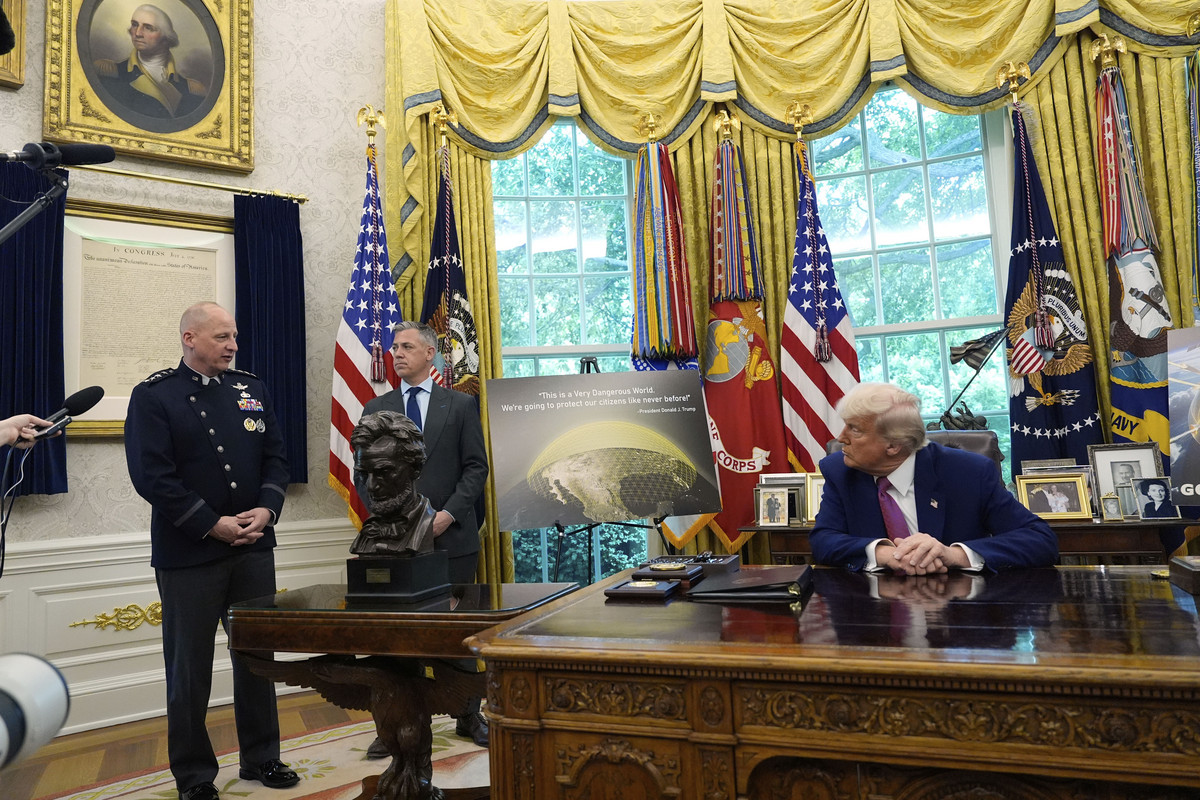
The program previously received $23 billion through a reconciliation package passed in the summer of 2025, though implementation ran into delays, according to Politico. Guetlein met with Trump in the Oval Office in May 2025 to discuss the project as the administration was building momentum behind the concept.
Context
The Golden Dome concept is modeled in part on Israel's Iron Dome air defense system but is intended to operate at a far greater scale — covering the continental United States against ballistic missiles, cruise missiles, and hypersonic weapons. The total cost estimates, which range from $185 billion to $3 trillion according to Politico and the American Enterprise Institute, reflect the extraordinary engineering and logistics challenge involved.
Budget reconciliation, which the administration has leaned on to fund the program, is a process that bypasses the Senate filibuster by attaching spending provisions to broader fiscal legislation. It requires a simple majority rather than the 60-vote threshold that most major legislation requires. But it remains a blunt instrument, and some Republican lawmakers — particularly those on appropriations committees — have expressed a preference for funding major programs through the regular appropriations process, where they retain more oversight authority.
The program has faced skepticism about its technical scope since early in its development. In February 2026, Politico reported that Golden Dome was struggling to take shape more than a year after Trump made it a signature defense priority. The April 15 warning from Guetlein that space-based interceptors might be too expensive to deploy marked a further narrowing of the original ambition.
What's Next
The immediate legislative question is whether Republican leaders in the House and Senate can advance a reconciliation package that includes the Pentagon's requested $17 billion for Golden Dome, according to Politico. Calvert's skepticism suggests that at minimum, the administration will need to persuade key appropriators that reconciliation is the appropriate vehicle for a program of this cost and complexity.
Pentagon officials have not yet shared detailed spending plans with some members of the House Armed Services subcommittee, Politico reported — a gap that could complicate efforts to build the congressional support the program needs. Guetlein's 2028 target for initial sensor capability gives lawmakers a concrete benchmark against which to measure progress, but reaching that milestone depends on the funding materializing in the near term.
Never Miss a Signal
Get the latest breaking news and daily briefings from Zero Signal News directly to your inbox.