
War Powers Deadline Arrives as White House and Congress Clash Over Iran Authorization
Zero Signal Staff
Published April 30, 2026 at 11:36 PM ET · 149 days ago
CBS News
President Donald Trump faces a 60-day War Powers Resolution deadline on May 1, 2026, requiring him to terminate or obtain congressional authorization for military operations against Iran that began February 28.
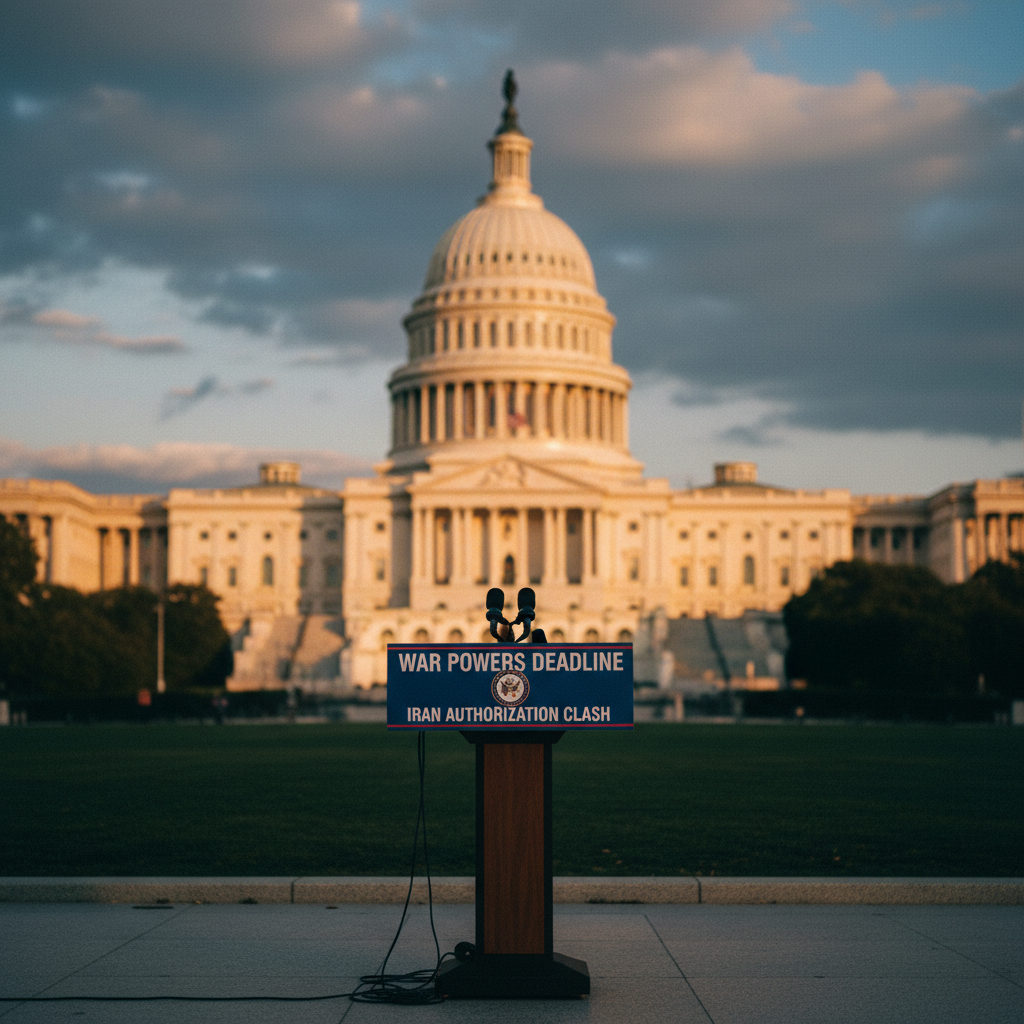
President Donald Trump faces a 60-day War Powers Resolution deadline on May 1, 2026, requiring him to terminate or obtain congressional authorization for military operations against Iran that began February 28. The White House contends that an April 8 ceasefire pauses the legal clock — a position challenged immediately by senators and legal analysts. Congress has not authorized the conflict, and no authorization measure has been formally introduced.
The Details
Trump formally notified Congress of hostilities with Iran in a March 2 letter, according to CBS News. Under the 1973 War Powers Resolution, that notification triggered a 60-day countdown with the deadline falling on May 1. The law, whose full text is preserved by the Avalon Project at Yale Law School, requires the president to terminate the use of U.S. armed forces within 60 calendar days after a Section 4(a)(1) report is submitted or required — unless Congress declares war, authorizes the action, or extends the period by law. The statute also allows up to 30 extra days for safe withdrawal only.
Defense Secretary Pete Hegseth offered the administration's legal interpretation during Senate Armed Services Committee testimony, as reported by CBS News and CNBC. "We are in a ceasefire right now, which in our understanding means the 60-day clock pauses or stops in a ceasefire," Hegseth said. Sen. Tim Kaine disputed that reading on the spot. "I do not believe the statute would support that," CNBC reported Kaine saying.
David Janovsky of the Project on Government Oversight also rejected the administration's position, according to CBS News. "It's not a 30-day blank check for the president to continue whatever hostilities he sees fit," Janovsky said. The fighting has been mostly paused since the U.S. and Iran agreed to a ceasefire on April 8 to allow for talks on a broader settlement, CBS News reported. The broader conflict, however, remains unresolved.
White House officials were in active conversations with members of Congress about possible congressional authorization for the war ahead of the deadline, CBS News reported. Republican Sen. Lisa Murkowski is drafting an authorization for the use of military force in Iran, but has not introduced the measure and support remains uncertain, CBS News reported. Democratic efforts to curb Trump's war powers have so far failed, CNN reported, and some Republicans have signaled Congress should vote if hostilities continue beyond 60 days.
The precise start of the legal clock is itself in dispute. CNN reported some lawmakers count from the February 28 start of hostilities — which would imply an April 29 deadline — while others count from the March 2 notification letter, yielding a May 1 date. CBS News and CNBC both frame May 1 as the operative deadline. CNBC separately confirmed that Congress has not authorized the military action against Iran.
Context
The War Powers Resolution was enacted in 1973 over President Richard Nixon's veto to constrain unilateral presidential war-making, according to CNN and the Avalon Project at Yale Law School. The law was designed to ensure Congress retains a formal check on sustained military campaigns by compelling the executive branch to seek legislative approval within a defined window.
Yet that constraint has rarely succeeded in practice. CBS News reported that Congress has never successfully used the War Powers Resolution to end a military campaign, making the current standoff as much a political struggle as a legal one. Democratic efforts to invoke the statute to limit Trump's authority have failed, CNN reported.
The conflict has also generated economic pressure beyond Capitol Hill. CNBC reported the fighting has fed an energy crisis tied to the Strait of Hormuz, increasing pressure on the White House as talks with Tehran stall. Republican Sen. Susan Collins, who voted for Democrats' latest War Powers measure, offered a direct warning. "The upcoming 60-day deadline is not a suggestion; it is a requirement," Collins said, according to CNBC.
What's Next
With the May 1 deadline landing, the White House and Congress face concrete choices. CBS News reported that White House officials were in active talks with lawmakers about a formal authorization for the use of military force. Sen. Murkowski's draft authorization remains unintroduced and support is uncertain, CBS News reported.
CNN reported that some Republicans have signaled Congress should vote if military operations continue beyond the 60-day mark. Without a congressional authorization, a formal extension, or a declaration of war, the administration will continue to face legal challenges and political pressure from lawmakers on both sides who argue the statute demands action.
Never Miss a Signal
Get the latest breaking news and daily briefings from Zero Signal News directly to your inbox.