
White House Drug Strategy Draft Proposes National Wastewater Surveillance Network and AI Cargo Screening
Zero Signal Staff
Published May 1, 2026 at 12:25 PM ET · 148 days ago
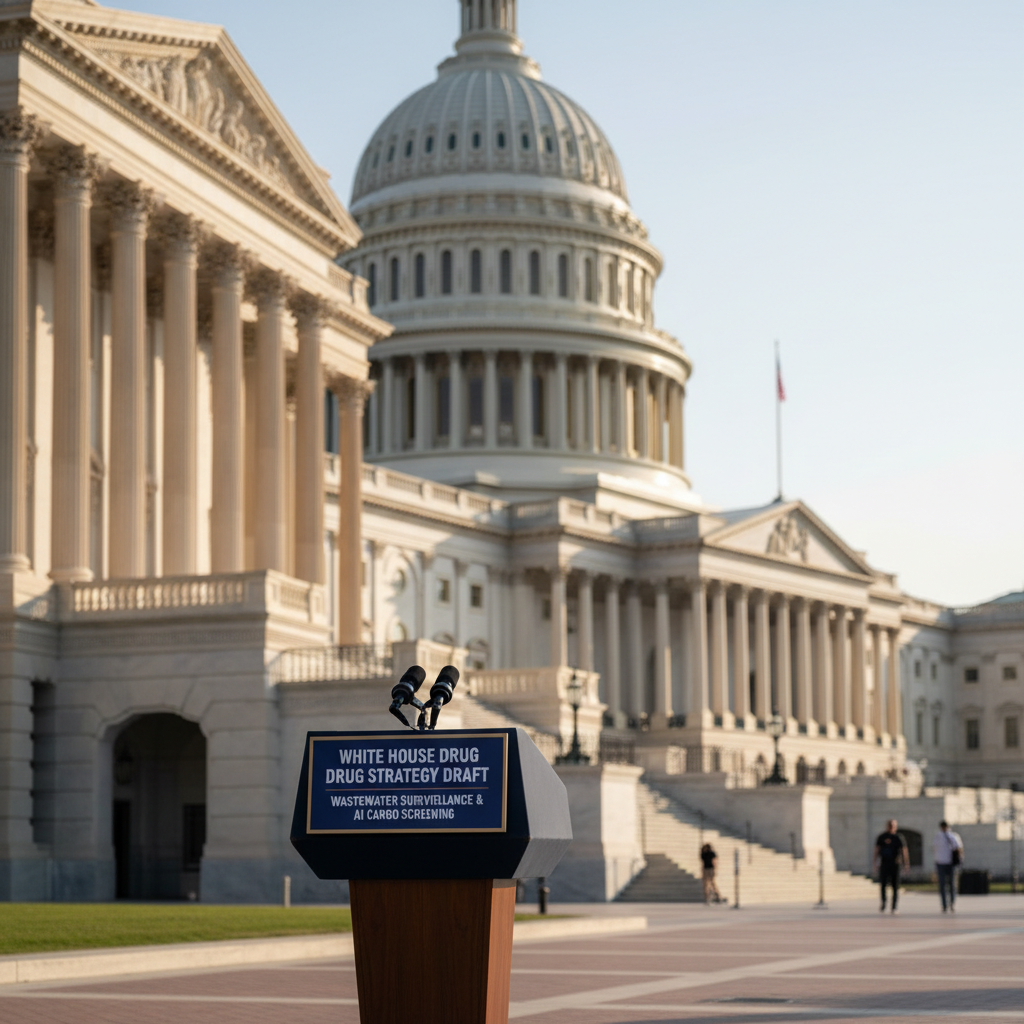
The Trump administration is preparing to release a 195-page national drug control strategy that would establish a nationwide wastewater monitoring system, apply artificial intelligence to screen cargo at ports of entry, and broaden access to addictio
The Trump administration is preparing to release a 195-page national drug control strategy that would establish a nationwide wastewater monitoring system, apply artificial intelligence to screen cargo at ports of entry, and broaden access to addiction treatment, CBS News reported on May 1, 2026. CBS News said it obtained a draft of the document, which sources indicated the White House planned to release the following week. The proposal pairs expanded surveillance and interdiction tools with treatment measures, including medication-based care for opioid use disorder and a goal of making the overdose-reversal drug naloxone as widely available as epinephrine.
The Details
According to CBS News, the draft strategy would create a national wastewater-based monitoring system alongside broader biosurveillance capabilities designed to track drug consumption and trafficking patterns in near real time. The document, as quoted by CBS News, states: "We will also prioritize establishing new data systems to monitor drug consumption in real-time, through a national wastewater-based monitoring system and biosurveillance."
The wastewater surveillance component builds on a program already underway. In January 2026, the White House Office of National Drug Control Policy awarded a contract to Biobot Analytics to provide nationwide wastewater intelligence covering more than 20 chemical targets, according to a PR Newswire announcement of that contract. Victor Avila, who was then serving as acting director of ONDCP, said at the time: "Wastewater gives us powerful, near real-time, data on drugs that are damaging our communities."
CBS News also reported that the draft proposes applying artificial intelligence to screen cargo for illicit drugs at ports of entry, mining electronic health records to identify individuals at elevated overdose risk, and using search algorithms to detect emerging drug threats. Those AI and electronic health record provisions are based solely on CBS News's reporting from the draft document and have not been independently confirmed in separately published government materials.
On the treatment side, CBS News reported the draft calls for easier access to addiction care, integrated medical treatment, support for medication-based treatment of opioid use disorder, and expanded availability of naloxone. The draft also incorporates faith-based language on prevention and recovery, with CBS News quoting the document as saying: "Secular education and treatment are important, but for those who have faith, adding God into the equation brings in a special power."
One area of potential tension in the draft involves fentanyl test strips. CBS News reported that SAMHSA recently issued a letter indicating fentanyl test strips cannot be purchased with federal grants. SAMHSA's own overdose-prevention materials, however, describe certain grant programs as eligible to fund fentanyl and xylazine test strips. The apparent discrepancy may reflect a difference in program scope or timing, and neither agency had issued a reconciling public statement as of CBS News's reporting.
Context
The national drug control strategy is coordinated by ONDCP, which oversees drug-policy efforts across 18 federal agencies and manages federal funding for prevention, treatment, and recovery programs, according to ONDCP's program descriptions cited in the Biobot Analytics contract announcement. Sara Carter was confirmed by the Senate in January 2026 as director of ONDCP, according to a White House release, giving the administration a confirmed political lead for the strategy's rollout.
In April 2026, ONDCP convened senior government leaders to review seizure-tracking data systems and emerging threat vectors for fentanyl and synthetic drugs, the White House said in a briefings-statements release. At that meeting, ONDCP Director Sara Carter stated: "Under President Trump's leadership, we are strengthening our borders to keep illicit drugs out of our country." That meeting reflected the administration's simultaneous focus on domestic overdose prevention and cartel-focused interdiction — the same combination that appears throughout the CBS-reported draft.
Overdose deaths remain substantially elevated above pre-opioid-crisis levels, according to provisional data from the CDC's Vital Statistics Rapid Release overdose dashboard. That ongoing toll provides the public-health backdrop against which the administration is framing the strategy as both a supply-side enforcement initiative and a domestic treatment intervention.
What's Next
The White House was expected to release the full 195-page strategy document the week of May 4, 2026, according to sources cited by CBS News. Once published, the complete text will allow public scrutiny of the AI cargo-screening and electronic health record provisions, which remain based solely on CBS News's draft reporting until the administration makes the plan public.
The strategy will also invite questions over the fentanyl test strip funding question. A reconciliation of the apparent discrepancy between the SAMHSA letter described by CBS News and SAMHSA's existing grant-program guidance had not been publicly issued as of May 1, 2026.
Never Miss a Signal
Get the latest breaking news and daily briefings from Zero Signal News directly to your inbox.