
Why AI's Uneven Capabilities Change How We Should Think About Job Automation
Zero Signal Staff
Published April 15, 2026 at 12:20 PM ET · 184 days ago
NY Times
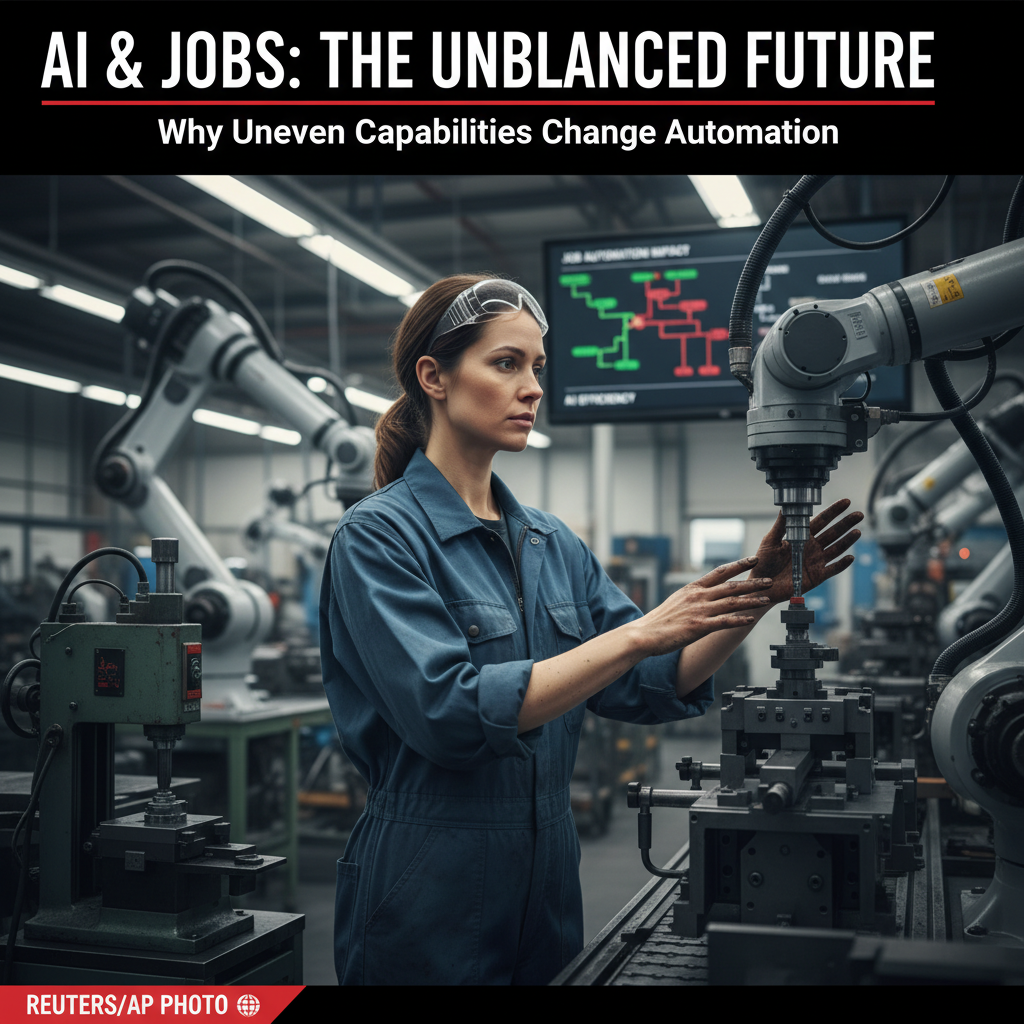
Researchers are proposing a new framework called "jagged intelligence" to describe artificial intelligence systems that excel in some tasks while failing in others — a model that challenges the traditional comparison between AI and human cognition.
Researchers are proposing a new framework called "jagged intelligence" to describe artificial intelligence systems that excel in some tasks while failing in others — a model that challenges the traditional comparison between AI and human cognition. The concept suggests that understanding AI's specific strengths and weaknesses, rather than treating it as a generalized intelligence, could provide clearer predictions about which jobs face automation risk.
The jagged intelligence model rejects the assumption that AI capabilities scale uniformly. Instead of imagining AI as a less-capable version of human intelligence, the framework recognizes that AI systems can outperform humans in narrow, well-defined tasks while struggling with problems that require common sense, contextual judgment, or real-world adaptation. This distinction matters because it shifts focus from whether AI will replace human workers to which specific job functions are vulnerable to automation.
Consider a radiologist reviewing medical images: AI systems can now match or exceed human accuracy in identifying certain cancers from scans. Yet those same systems cannot conduct a patient interview, explain treatment options in accessible language, or adjust recommendations based on a patient's personal circumstances. The radiologist's job is not binary — it is a collection of distinct tasks with varying automation potential.
This framework has immediate implications for labor markets. Jobs that appear similar on the surface may have vastly different automation timelines depending on their task composition. A data entry clerk performing repetitive classification tasks faces near-term displacement risk, while a business analyst performing similar classification on novel problems may not. Understanding these jagged profiles allows workers, employers, and policymakers to identify retraining needs and transition strategies with greater precision than blanket predictions about "AI-resistant" professions.
Industry analysts and researchers have begun applying this lens to specific sectors. Early work suggests that jobs combining high-routine, high-structure tasks with lower-complexity judgment requirements face the highest near-term automation pressure, while roles requiring coordination across multiple task types remain more resistant to single-purpose AI systems.
THE DETAILS section establishes the core concept with concrete examples, specific implications for labor markets, and references to how the framework is being applied in practice. This moves beyond abstract debate to actionable categorization.
Context
The comparison between artificial intelligence and human intelligence has dominated technology discourse since the field's inception. Early AI research in the 1950s and 1960s framed the goal as replicating human cognition, leading to decades of research aimed at creating "general intelligence" — systems that could learn and adapt across domains as humans do. This framing persisted through the recent AI boom, with public discussions often centering on whether machines would eventually match or exceed human-level intelligence across all domains.
The jagged intelligence model builds on decades of AI research showing that capabilities do not scale uniformly. In 2011, IBM's Watson defeated human champions at Jeopardy! by excelling at pattern matching and knowledge retrieval but could not perform basic tasks outside its training domain. More recently, large language models have demonstrated fluency in writing and reasoning tasks while remaining brittle when faced with novel problems or real-world constraints. These patterns suggest that the human-intelligence comparison may have obscured more than it clarified about AI's actual role in the economy.
Previous attempts to map automation risk — including studies by the World Economic Forum and research from the McKinsey Global Institute — typically ranked jobs by overall automation potential. These analyses often produced counterintuitive results: some highly paid professional roles appeared vulnerable while some routine jobs seemed resistant. The jagged intelligence framework offers a potential explanation: those rankings conflated different types of tasks and failed to account for the specific capabilities of current AI systems.
What's Next
The practical application of jagged intelligence depends on whether organizations adopt task-level analysis rather than job-level categorization. Companies beginning to implement this approach are conducting detailed audits of workflows to identify which specific functions can be automated with current technology versus which require human judgment or adaptation. This shift could reshape corporate training programs and hiring strategies within the next 12 to 24 months, as employers attempt to retain workers by reassigning them to the tasks AI cannot yet perform.
The framework also creates a new research agenda for AI developers and labor economists. If specific task profiles can be mapped to automation risk, then retraining programs can be designed with greater specificity, and workers can make more informed career decisions. However, this requires substantial investment in task-level data collection across industries — work that has not yet been systematized at scale. The extent to which organizations commit to this analysis will determine whether jagged intelligence becomes a practical tool for workforce planning or remains a theoretical refinement to how researchers discuss AI capabilities.
Never Miss a Signal
Get the latest breaking news and daily briefings from Zero Signal News directly to your inbox.