
Zoox Built Its Robotaxi Around the Sensors, Not the Other Way Around
Zero Signal Staff
Published April 28, 2026 at 5:02 PM ET · 151 days ago
Ars Technica; Reuters; CNBC; Automotive News
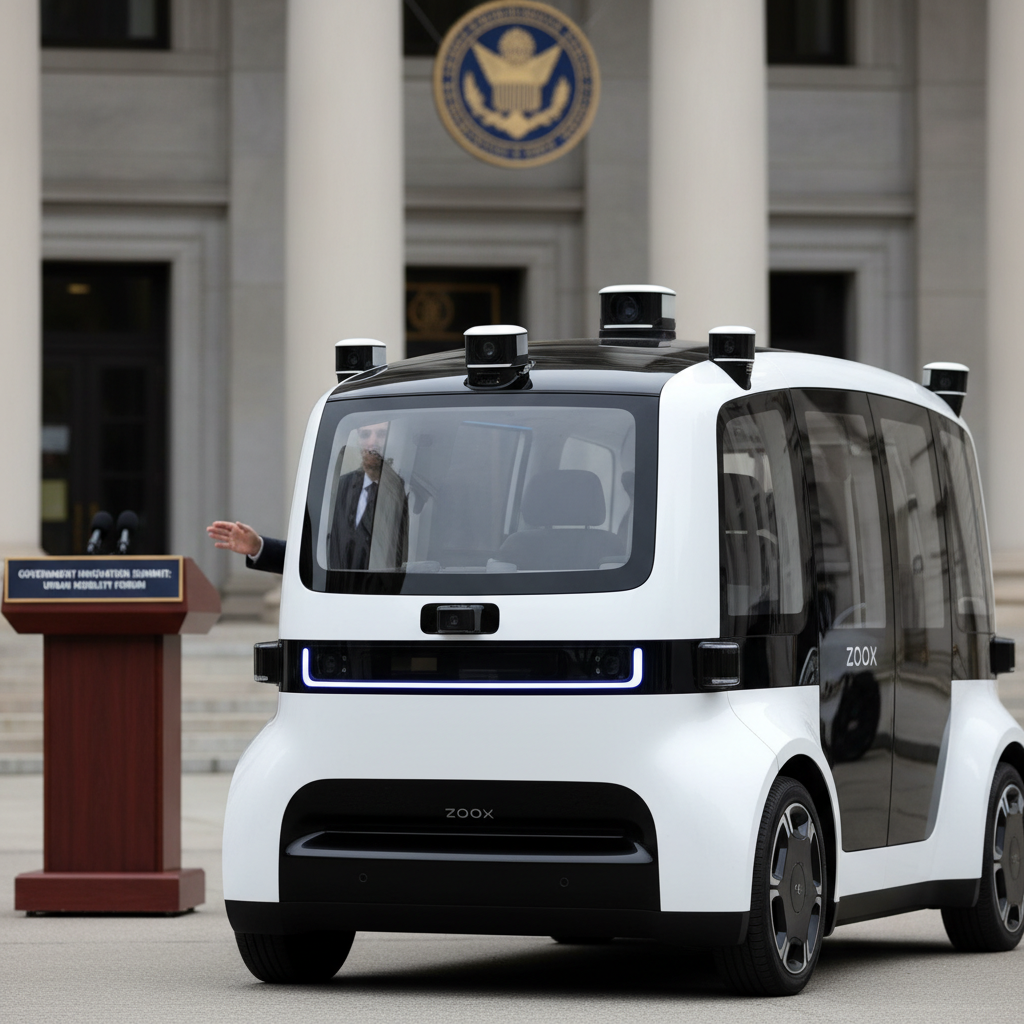
Amazon-owned Zoox designed its robotaxi as a purpose-built autonomous vehicle from the ground up — sensors first, body second — a deliberate departure from the retrofit approach that still dominates U.S. autonomous vehicle development.
Amazon-owned Zoox designed its robotaxi as a purpose-built autonomous vehicle from the ground up — sensors first, body second — a deliberate departure from the retrofit approach that still dominates U.S. autonomous vehicle development. Ars Technica reported the design rationale this week in an interview with Zoox executives, offering the most detailed public account yet of why the company chose to build a bespoke platform rather than adapt an existing passenger car.
The Details
The core premise of Zoox's design, according to Zoox director of robot industrial design and studio engineering Chris Stoffel in his remarks to Ars Technica, is that a robotaxi is fundamentally a different machine than a car. 'A robotaxi is not a car; it's not a human-driven vehicle, and the requirements are wildly different, although it has to live in that world,' Stoffel told Ars Technica.
That starting assumption shaped every subsequent engineering choice. Ars Technica reports that the Zoox vehicle places its sensor pods at the four upper corners of the body rather than mounting them atop a conventional roof or tucking them around a hood. According to Zoox director of sensor engineering Ryan McMichaels, the hooodless front end was essential to that placement: 'Because we don't have a traditional hood, we've optimized our frontal coverage in a way that would be nearly impossible on a retrofitted vehicle.'
The absence of a hood is not incidental. It is, according to Ars Technica's reporting on Zoox executives' account, a direct consequence of designing without a human driver. Conventional vehicles are built around a cockpit — steering column, pedal cluster, driver sight lines. A purpose-built robotaxi has none of those constraints, which freed Zoox's engineers to treat sensor placement as the primary spatial requirement rather than an afterthought layered onto an existing chassis.
Ars Technica also reports that the vehicle uses a symmetrical, bidirectional layout, with matching steering capability at both axles. Zoox executives told Ars Technica this configuration improves both maneuverability in dense urban environments and system redundancy — if one end of the vehicle needs to take the lead, the platform is mechanically capable of it. The bidirectional design means the vehicle has no fixed front or back, a practical advantage in tight turnarounds and multi-point urban routes.
Taken together, the design choices described by Zoox executives to Ars Technica illustrate a specific engineering thesis: that the freedom to ignore conventional automotive form unlocks sensor coverage, redundancy, and maneuverability gains that are difficult or impossible to achieve by modifying production vehicles. Most U.S. robotaxi developers, as noted by Ars Technica, Automotive News, and Reuters, continue to work with retrofitted conventional vehicles. Zoox is among the highest-profile efforts building a fully bespoke platform.
Context
Zoox has operated as an Amazon subsidiary since 2020, when Amazon acquired the company in a deal that gave the e-commerce giant a direct stake in the autonomous vehicle race. The Zoox robotaxi is not a research prototype; it is a vehicle the company has been expanding into real service environments.
Reuters reported in March 2026 that Zoox planned to widen its U.S. robotaxi footprint by expanding service in San Francisco and Las Vegas while moving into Austin and Miami. CNBC likewise reported in March 2026 that Zoox expected to debut robotaxis in Austin and Miami later in 2026, pending regulatory approvals for paid rides.
That commercial trajectory gives the design story weight beyond engineering theory. The sensor layout and bidirectional platform Zoox executives described to Ars Technica are the same architecture now operating and expanding in real U.S. cities, not a concept under development. When Zoox says the purpose-built form factor enables visibility and maneuverability advantages, the claim is attached to vehicles already running scheduled routes.
The broader autonomous vehicle industry has largely pursued a different path. Waymo, Cruise, and most other U.S. competitors began — or continue — with retrofitted production vehicles, modifying existing platforms to carry the sensor and compute stacks required for full autonomy. The retrofit approach reduces development cost and time to initial deployment, but Zoox executives' comments to Ars Technica suggest the company views the long-term engineering tradeoffs as favoring a clean-sheet design, particularly for sensor placement and vehicle symmetry.
What's Next
Zoox's near-term milestones are tied to its city expansion plan. CNBC reported in March 2026 that the company expected Austin and Miami deployments later in 2026, contingent on regulatory approvals for fare-charging service. San Francisco and Las Vegas, where Zoox already operates, are slated for expanded coverage, Reuters reported in the same period.
The Ars Technica interview with Zoox executives does not detail a production timeline or manufacturing scale targets, so the pace at which the purpose-built platform moves from current testing footprints to broader commercial deployment remains an open question based on the sourced record.
Never Miss a Signal
Get the latest breaking news and daily briefings from Zero Signal News directly to your inbox.